
Promotion of Sustainable Procurement
Approach and Policy
The NGK Group bases its procurement activities on the principles of social responsibility, openness, and mutual prosperity. We conduct fair and equitable transactions with suppliers and aim to achieve sustainable growth together. To put these principles into practice, we have established the NGK Group Procurement Policy and are advancing related initiatives. We also support the Declaration of Partnership Building promoted by the Cabinet Office and the Small and Medium Enterprise Agency of Japan, and continue to foster mutual prosperity with suppliers through appropriate and fair business practices.
NGK Group Procurement Policy
Promotion Framework
The NGK Group manages suppliers that have direct business relationships with us through our Purchasing Department. For critical purchased materials, including raw materials, we also manage suppliers beyond the first tier.
We promote supply chain management initiatives through the Sustainability Management Committee. Depending on the nature and significance of the issue, related committees, including the Environmental Action Subcommittee and the Human Rights Subcommittee, work closely with relevant departments to advance these initiatives. Matters discussed and reported at the Sustainability Management Committee are also reported regularly to the Board of Directors.

Initiatives
NGK Group Supplier Code of Conduct
The NGK Group aims to realize a sustainable society together with its suppliers and has established the NGK Group Supplier Code of Conduct. Under this Code, we require suppliers to fulfill important responsibilities throughout the supply chain, including the prohibition of forced labor in the area of human rights and the reduction of greenhouse gas emissions in the area of the environment. We ask our major and registered suppliers to agree to comply with the Code. We make this request when engaging new suppliers and annually for existing suppliers.
Supplier Assessment
Definition of Suppliers
The NGK Group identifies major and registered suppliers based on the following criteria:
| Perspective | Criteria |
|---|---|
| Importance | Suppliers of raw materials, equipment, and other items essential to manufacturing |
| Difficulty of Replacement | Suppliers that are difficult to replace with alternative sources |
| Transaction Volume | Suppliers ranked among the highest in purchasing value within each business division |
- Number of Major and Registered Suppliers: Approximately 3,000 companies (as of June 2026)
New Supplier Assessment
NGK selects new suppliers based on its principle of open, fair, and equitable procurement. We evaluate potential suppliers from the perspectives of quality, cost, delivery (QCD), and stable supply. In addition, to fulfill our social responsibilities throughout the supply chain, we require all prospective suppliers to understand the intent of the NGK Group Supplier Code of Conduct, which incorporates ESG considerations, and to agree to comply with it as a mandatory condition for doing business with us.

Existing Supplier Assessment
NGK requires existing suppliers to submit an annual agreement confirming compliance with the NGK Group Supplier Code of Conduct. In addition, to enhance the accuracy of our sustainability assessments, we conduct a survey consisting of 96 questions across nine categories, including human rights, labor, and the environment, and evaluate risks based on the nature of each business relationship.
Taking the potential impact on our business into account, we began this survey with direct material suppliers and are gradually expanding its scope to major suppliers in Japan and overseas. In FY2025, we revised the survey content to align with the NGK Group Code of Conduct, which was comprehensively updated in the previous fiscal year.
- Human Rights/Labor
- Health and Safety
- Environment
- Fairness and Ethics
- Quality/Safety
- Information Security
- Business Continuity Plan (BCP)
- Community and Social Engagement
- Management System
Communication Activities with Suppliers
Explanation of Earnings to Suppliers
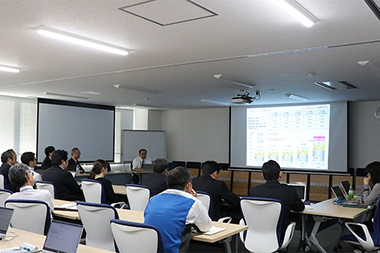
NGK holds an annual supplier meeting to share the Group’s business performance, management policies, annual business plans, and procurement policy with major suppliers and to strengthen communication. In FY2025, 110 companies attended in person and approximately 70 companies participated online. We shared information to support business continuity and sustainable growth across the supply chain.
Review and Strengthen Communication with Suppliers
NGK continues to improve communication throughout the supply chain by conducting regular price negotiations to support appropriate price pass-through and by reviewing methods for sending and receiving emails to strengthen IT security.
We also regularly share our initiatives with suppliers and provide opportunities for dialogue on topics such as harassment prevention, the development of a business continuity plan (BCP), and IT security. In addition, we accept inquiries and consultations from Japan and overseas through our supplier helpline and work to identify and resolve issues at an early stage.
Visiting and Monitoring Suppliers
NGK conducts on-site visits and audits in Japan and overseas to ensure fair evaluations of quality, cost, and delivery (QCD) and to procure products and services from the most suitable suppliers. In FY2025, we conducted quality audits of 54 suppliers, including 36 key suppliers. In addition to providing evaluations and feedback, we use factory surveys and delivery schedule reviews to assess suppliers’ QCD management systems and sustainability initiatives. We also strengthen relationships with suppliers through both in-person visits and web-based communication.
Training and Support Programs for Suppliers
NGK works to enhance safety awareness through the NGK Safety Cooperation Conference, which consists of construction-related suppliers. We hold an annual safety conference where we share examples of accidents and incidents and offer lectures on workplace safety. In FY2025, 82 participants from 49 member companies attended the conference and took part in special lectures on safety management and mental health.
Collaboration with External Organizations for Sustainable Procurement
The NGK Group has participated in the UN Global Compact since 2015. We support its Ten Principles covering human rights, labor, the environment, and anti-corruption, and contribute to the realization of a sustainable society through our business activities. We also participate in the Supply Chain Subcommittee, where we engage in activities to build an environment that supports sustainable procurement. We incorporate the insights gained through these activities into the NGK Group’s procurement practices.
Enhancement of NGK Group-Wide Cooperation and Procurement Capabilities
The NGK Group strengthens its procurement capabilities and enhances governance through information sharing and joint procurement initiatives with Group companies. We improve procurement practices by consolidating purchases of common materials, sharing cost and supplier information, and introducing supplier management methods for domestic business partners. These efforts help us identify challenges and implement improvements based on the procurement structures and business practices of each Group company.
Going forward, we will continue to enhance the NGK Group’s procurement function by expanding consolidated purchasing and standardizing supplier management methods across the Group. Through these initiatives, we aim to improve both cost efficiency and governance.
Procuring Resources and Raw Materials Responsibly
The NGK Group conducts procurement activities that consider impacts on regional communities stemming from the use of raw materials (e.g. conflict minerals) with the potential to cause social issues such as human rights violations and poverty, and takes steps to avoid using such materials. Additionally, in response to requests from customers, we investigate suppliers regarding their responsible procurement of resources and raw materials.