Water Resource Conservation
Approach
Based on the NGK Group Environmental Vision, the NGK Group positions the sustainable use of water resources as one of its key issues.
We use water in our primary ceramics manufacturing business. By improving water-use efficiency and appropriately managing water-related risks, we aim to reduce environmental impact while ensuring stable business operations.
This initiative is positioned under “Promotion of resource recycling” in line with our materiality. In the sixth 5-Year Environmental Action Plan, however, water resource conservation is categorized under “harmony with nature.”
Metrics and Targets
Targets and Achievements
Under the fifth 5-Year Environmental Action Plan, the NGK Group uses water withdrawal per unit of sales as an indicator. We set a target to maintain the FY2019 level of 1,000 m3 per 100 million yen in sales. In FY2025, we achieved this target at 601 m3 per 100 million yen.
From FY2026, under the sixth 5-Year Environmental Action Plan, we aim to reduce the five-year average water withdrawal per unit of sales by 0.5% each year.
Initiatives
Handling and Risk Management of Water Resources
Based on a sustainability perspective, the NGK Group works to manage risks related to water resources and improve water-use efficiency.
We use the LEAP approach recommended by the Taskforce on Nature-related Financial Disclosures (TNFD) to investigate and assess how water withdrawal and wastewater at each domestic and overseas site depend on and impact water resources in surrounding areas.
In FY2025, we conducted a reassessment of water risks based on previous evaluations and reviewed sites with potential water risks. Based on these results, we prioritize sites where risks are identified and work with local teams to confirm detailed information and initiatives related to water use, while further improving water-use efficiency.
There were no significant violations of standards or regulations related to wastewater quality at any domestic or overseas sites.
Evaluation of Water Risks
The NGK Group conducts self-assessments of water shortage risks across all production sites in Japan and overseas, and also performs detailed third-party analyses, particularly for overseas sites.
In the detailed analyses, we evaluate factors such as water stress*, groundwater stress, seasonal variations in water supply, and reservoir capacity. We also forecast future water supply and demand. In addition, we carry out comprehensive risk assessments that include water-related disaster risks, such as floods and landslides, and water quality risks related to public health and ecosystems.
As a result, some sites in Asia and North America are located in river basins with high water stress. Water withdrawal at these sites was 125,000 m3 in FY2025, accounting for 3% of the Group total.
We use these assessment results to understand water risks at each site and share information across the Group. In regions with high water stress, we consider and promote measures such as improving water-use efficiency and utilizing recycled water.
At present, no serious water risks have been identified at any sites. However, we continue to monitor regulatory trends and will promote further improvements in water-use efficiency as needed.
| Region | Water supply and demand | Water disasters | Vulnerability to water pollution | ||
|---|---|---|---|---|---|
| Current | 2050 | Public health | Ecosystems | ||
| North America | 0 | 2 | 0 | 0 | 1 |
| Europe | 0 | 0 | 0 | 0 | 1 |
| Japan, Asia and Australia | 1 | 2 | 0 | 1 | 1 |
- *Water stress refers to a condition in which water supply and demand are under strain. In this context, we use the ratio of water withdrawal to available water supply as an evaluation indicator
Improving Water-Use Efficiency and Expanding Initiatives Across the Supply Chain
The NGK Group aims to optimize water use by developing guidelines that also serve as checklists and by conducting assessments using these tools.
We will further enhance these guidelines by leveraging findings from surveys at Group sites and from other companies, and we will continue to promote improvements in water-use efficiency.
In addition, we assess water risks of key suppliers using the Aqueduct analysis tool and aim to strengthen risk management across the supply chain.
Initiatives at Group Companies
Use of Recycled Water at Production Sites
The NGK Group recognizes that water resources are essential to its manufacturing processes. To address this, we improve water-use efficiency and appropriately manage water-related risks to reduce environmental impact while ensuring stable business operations. As part of these efforts, some production sites use recycled water in accordance with the characteristics of their manufacturing processes.
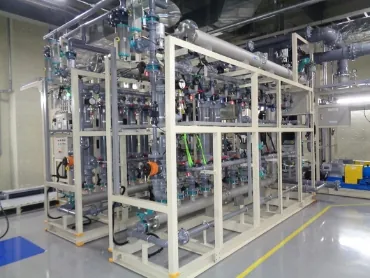
At NGK Ceramic Device (NCDK) Komaki Plant, the processing of bonded wafers for surface acoustic wave (SAW) filters requires a relatively large amount of water. To address this, the plant introduced a system that uses recycled water filtered through ceramic membranes, and began operations in FY2022. Through this system, approximately 28,000 m3 of the annual water withdrawal of about 160,000 m3 was supplied by recycled water in FY2025.
At NCDK Fujiyoshida Plant, which has a similar process, equipment with greater processing capacity has been introduced. This enables efficient water use even in Japan, where water supply risks are relatively low.
Detailed Assessment at Water-Stressed Sites
As part of its risk management efforts for water risks, the NGK Group conducts detailed assessments of water use at sites located in areas with high water stress.
For example, at NGK Ceramics Mexico, we assess water stress in the river basin from which water is withdrawn. Through these efforts, we work to identify and reduce water-related risks.