
Governance

Risk Management

Basic Approach

The NGK Group considers uncertainties which may affect achievement of the Group Vision to be risks. We have established an approach of handling risks according to their type, which enables us to control these risks by appropriately recognizing and preventing them, and to minimize losses caused by risks that do materialize.
Moreover, when risks that have a big impact on management occur, the committee tasked with handling the risk according to the Basic Rules of Crisis Management will lead the way in collecting information and ascertaining the situation. The NGK Group will then work to minimize the negative impacts, analyze the causes, and prevent recurrence. For extremely serious risks, the executive officer in charge of the Sustainability Management Dept. will convene a response meeting attended by the President to respond to the risk.

Risk Management Structure

In FY2023, the NGK Group established a new Risk Management Committee chaired by the President, and is comprehensively managing the Group's significant risk issues under the supervision of the Board of Directors in accordance with the risk management process described below. Risk Management Committee members perform management activities which include providing direction and support to each division and department for handling risks in the area they are responsible for. In addition to crafting and carrying out risk countermeasures, each business group and division also constantly monitors the materialization of risks and reports these results to the Risk Management Committee. At least once a year, the Risk Management Committee reports to the Board of Directors about risk management activities. Through this, the Board of Directors is able to supervise these efforts and verify the effectiveness of the risk management structure. The risk management structure in question, is managed independently of the Audit & Supervisory Board.
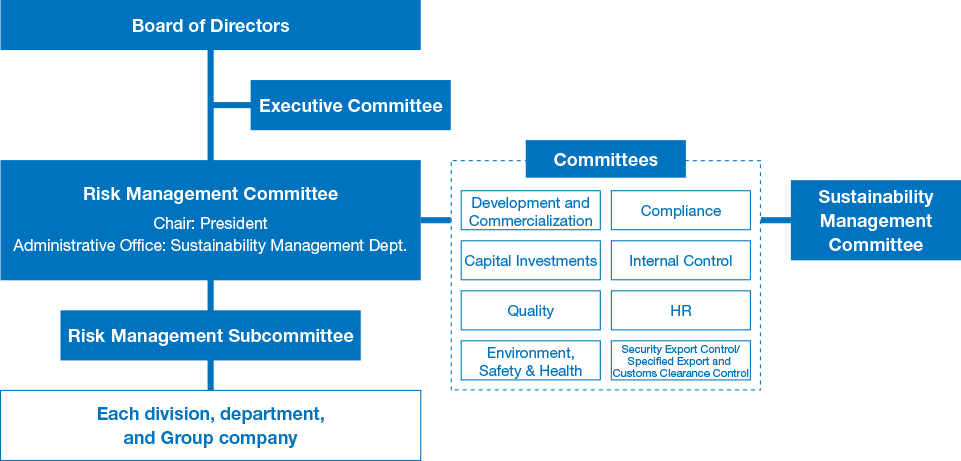
Risk Management Structure
This is an organizational chart of our risk management system. The Risk Management Committee handles NGK Group-wide risks, and reports to the Board of Directors. Individual risks are handled by the relevant committee.

Risk Management Process

The Board of Directors views uncertainty that affects the achievement of the NGK Group Vision as risk, and has decided on a concept of risk management to serve as our policy concerning risk management. It determines the approach to take on initiatives depending on the classification of risks as “risks NGK should take” or “risks NGK should avoid.” Under this approach, the Risk Management Committee periodically analyzes and evaluates risks, then identifies and reviews the material risks that should be managed based on changes in the internal and external environment, with reference to the COSO-ERM Framework*. It has also established a risk management structure and method for formulating and implementing countermeasures against risk and monitoring the manifestation of risks via the committees and departments in charge of managing risks. Once a year, we identify the risk factors impacting our business operations in both a top-down manner by management, and a bottom-up manner by each department, in order to identify and review critical risks. We check the level of impact of each risk, changes in the likelihood of their occurrence, and whether we are aware of new risks, then review our risk assessment. Through these efforts, the Risk Management Committee manages the risks facing the NGK Group in an interdisciplinary manner, and reports to the Board of Directors.
In order to flexibly address risks that have suddenly increased in importance due to abrupt changes in the internal and external environment, we make sure we are able to respond by adding them in a timely manner to the list of targets to be handled by the Risk Management Committee. Following the change of administration in the United States in FY2024, we held discussions focused on tariff policy and its impact on our business with outside experts at Risk Management Committee meetings.

  • *COSO-ERM: An international framework created by the Committee of Sponsoring Organizations of the Treadway Commission (COSO) in the USA, that aims to manage the risks facing businesses and integrate strategy and performance.
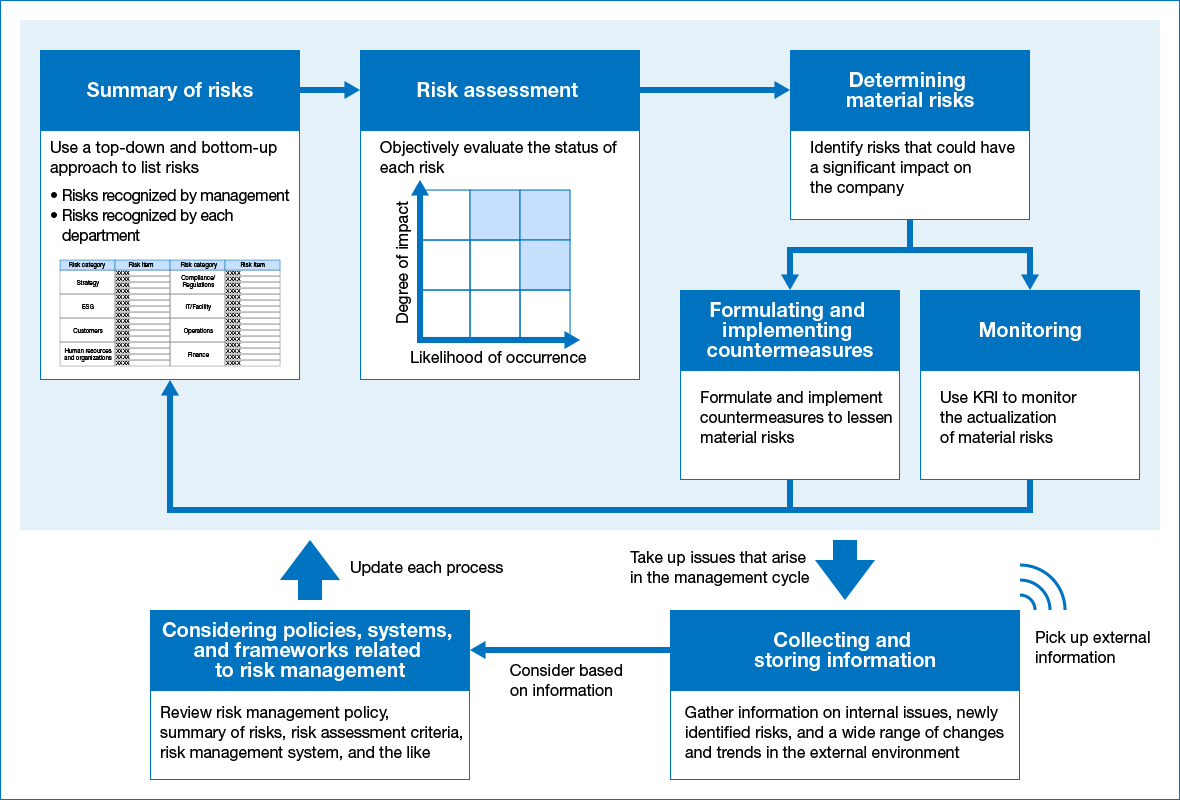
Material Risk Management Cycle
This figure shows the risk identification process. We identified the risks that should be managed as a group through the process of collecting, listing, and evaluating risks which were then deliberated on by senior management.

Risks, Summary, Response

1. Business operation risks All operations
Risk summary
  • Changes in things such as the politics of each country or region, the stability of their feelings towards Japan, laws, regulations, tax systems, infrastructure, tariffs, and incentives, which are the underlying assumptions for each business
Response
  • Construct alternative systems that are distributed globally among sites
Residual risk
  • Decline in revenue due to unforeseen matters impacting underlying assumptions, such as social unrest due to demonstrations, terrorism, war, infectious disease, and natural disasters
Environment Business
Risk summary
  • Changes linked to decline in demand for internal combustion engine vehicles
  • Decline in demand due to changes in consumer values and business model
  • Drop in market share due to rising competition from Chinese market
  • Drop in market share due to increased competition in kilns for lithium-ion battery cathode materials and electronic components
Response
  • Develop and launch new and high-performance products according to changes in demand
  • Support flexible production by monitoring trends in demand
  • Strengthen competitiveness in the Chinese market via technical responsiveness that anticipates environmental regulations, and via capacity to ensure stable supply
  • Maintain and improve competitiveness by monitoring the competitive situation with regards to industrial equipment products
Residual risk
  • Negative impact on performance and financial situation caused by greater than expected changes in demand, delays in responding to environmental regulations, and short-term decline in demand due to downturn in business
Digital Society Business
Risk summary
  • Decline in demand due to the state of supply and demand for semiconductors, regulation changes in each country, and technological innovation
  • Drop in market share due to delayed responsiveness to customer needs
  • Failure to achieve expected level of growth from significant changes in semiconductor manufacturing processes due to innovative inventions
  • Negative impact on business due to delay in responding to the increasing complexity of export restrictions on semiconductors from various countries
  • Decreased demand for final consumer goods and decreased investment in mobile phone base stations and data centers
Response
  • Carefully monitor customer trends and demand information, and revise equipment capacity, personnel systems, and production systems where appropriate to ensure quick response to changes in demand
  • Maintain our industry-leading position by improving our unique product responsiveness and product supply capacity
  • Carefully monitor regulatory trends, share information with related departments, and prepare necessary rules and manuals
Residual risk
  • Negative impact on performance and financial situation due to weak sales and inventory burden accompanying a larger than expected decline in demand
Energy & Industry Business
Risk summary
  • Adoption of polymer insulators in the Japanese market
  • Decline in revenue due to the impact of electric power policy and competition in overseas markets
Response
  • Maintain adoption by appealing to reliability based on utilization track record
  • Ensure demand by maintaining quality and improving cost competitiveness
Residual risk
  • Negative impact on performance and financial situation due to a larger than expected decline in demand
2. R&D-related risks
Risk summary
  • Failure to achieve New Value 1000* due to inability to fit the market, and sluggish creation and commercialization of new products
  • *New Value 1000: A target of reaching 100 billion yen in sales from new products and new businesses by 2030
Response
  • Promote the creation and commercialization of new products through collaboration between Corporate NV Creation, Corporate R&D, and Corporate Manufacturing Engineering, while actively adopting technologies and solutions from outside the company as well
  • Review the distribution of research and development resources in the Development and Commercialization Committee
Residual risk
  • Negative impact on performance because of the inability to achieve adequate results with the input received due to increasingly complicated technological competition
3. Personnel Risks Securing and managing personnel
Risk summary
  • Opportunity loss and negative impact on important decision-making because hiring and training desired personnel does not go as planned (global personnel, personnel for digital transformation, and people with a mindset to take on challenges without fear of failure)
Response
  • Diversify and optimize hiring methods to acquire personnel in line with our business strategy
  • Expand mechanisms and systems to secure and develop global personnel and personnel for digital transformation
  • Establish an internal environment that encourages employees—including those in key management positions—to take on challenges
Residual risk
  • If hiring and training personnel does not go as planned, we will not attain our business goals due to failure to improve business execution capabilities
Support diversity and inclusion
Risk summary
  • Loss of opportunities for innovation due to continued homogeneity of personnel
  • Decreased competitiveness in recruiting due to being seen as a company that is reluctant to promote diversity and inclusion
Response
  • Check the progress of implementation of personnel measures based on the NGK Group Human Capital Management Policy, and promote the construction of a framework for achieving our vision
  • Promote personnel policies that encourage the hiring and training of diverse personnel
Residual risk
  • Failure to achieve business targets and negative impact on performance and financial situation due to a stagnation in creating innovation that comes from being slow to promote diversity and inclusion
4. Legal compliance, human rights and safety, and quality-related risks Legal compliance-related risks
Risk summary
  • Negative impact on operating revenue and decline in our reputation, due to violations of laws and regulations, human rights violations, and conduct that violates social norms such as contract compliance
Response
  • Utilize employee training, handbook distribution, etc. to ensure employees are familiar with relevant laws and regulations and have a more compliance-focused mindset
  • Establishment of the NGK Group Basic Guidelines for Compliance Activities in accordance with international standards
  • The Business Ethics Committee, which comprises outside directors and compliance officers, watches out for critical improprieties or legal/regulatory violations
  • Reduce the possibility of compliance violations through a whistleblowing system
Residual risk
  • Negative impact on performance due to occurrence of unexpected problems
Human rights and safety-related risks
Risk summary
  • Occurrence of employment injuries and decline in reputation due to failure to comply with rules and insufficient awareness of risks
  • Personnel shortages and stagnant performance caused by declines in the mental health of employees
  • Human rights violations in the Group’s business activities
Response
  • In accordance with the NGK Safety and Health Policy, identify serious hazard risks and use risk assessment to facilitate strengthening of preventative measures
  • Follow up on employees who work long hours, and conduct job grade-specific mental health education
  • Formulate NGK Group Human Rights Policy
  • Conduct various types of education aimed at improving employee understanding of human rights
  • Prevent and reduce human rights violation risks through compliance with international norms related to human rights
  • Have Group companies perform self-checks, and request that our main suppliers comply with the NGK Group Supplier Code of Conduct
Residual risk
  • Negative impact on performance due to the occurrence of unexpected problems
Quality and product safety-related risks
Risk summary
  • Damage to NGK's brand reputation, lawsuits, etc. due to business deficiencies such as serious market complaints and breaches of contract
Response
  • Have Quality Management Department perform monitoring of each business group’s quality activities, in line with the NGK Quality Policy
  • Convene quality review meetings in order to quickly find a solution to serious issues
  • Improve work quality through company-wide quality compliance programs
  • Promote activities from the management level to the worksite which encourage employees to see compliance as their responsibility and reduce overburden, waste, and unevenness in operations
  • Improve quality by formulating rules for quality activities and stipulating the kind of quality that should be preserved, as well as expanding effective approaches and methods for eliminating quality risks throughout the entire company
  • Correct the causes of market defects, ensure the safety of products and services, and focus on analyzing quality risks in the intangible goods business
  • Enhance confirmation of warranty details and specifications requested by customers, and create a rapid notification system for when quality and safety risks occur
Residual risk
  • Negative impact on performance due to occurrence of quality issues that exceed expectations
5. Information systems-related risks
Risk summary
  • Negative impact on societal trust or business continuity due to shutdown of data processing, or to theft, destruction, manipulation, loss, etc., of data, following external cyber-attack or unauthorized system access, or after unexpected system failure or security issue
Response
  • Regularly share efforts taken by each Group company to raise the level of our Group-wide IT security system and measures based on the NGK Group Information Security Policy
  • Prevent security incidents through application and appropriate management of internal information assets and external cloud services
  • Conduct periodic information security training for employees to prevent information leaks and ensure appropriate use of software
  • Implement a security incident handling framework and prepare a manual to strengthen our response when incidents occur, and conduct response training for managers
Residual risk
  • Negative impact on societal trust, business continuity, or performance due to cyber-attacks that increase in severity and sophistication every year
6. Currency exchange, capital, and procurement-related risks
Risk summary
  • Decreased sales and profits and deterioration of business performance due to strong yen
  • Negative impact on operations, performance, and financial situation as a result of financing difficulties for activities such as capital investment stemming from financial crises and other factors
  • Negative impact on performance due to rise in price of materials and energy procurement and logistics costs
  • Delays in materials procurement and backlogged shipments to customers due to supply chain disruptions and lateness in responding to changing laws and regulations in Japan and supplier countries
  • Decline in our reputation and negative impact on operating revenue due to delays in the supply of certain materials and equipment, and violations of laws and regulations
Response
  • Keep production close to local demand centers, perform financing in local currency, and optimize purchasing according to currency exchange situation
  • Hedge risks with forward foreign exchange contracts and other financial instruments for handling short-term fluctuations
  • Appropriately reflect the rise in costs for materials and energy in sale price, and reduce costs through competitive purchasing, design revisions, and other means
  • Reduce risks in the supply chain by collecting information and monitoring conditions through overseas locations in an effort to diversify suppliers and optimize inventory control
Residual risk
  • Negative impact on operations, performance, and financial situation in the event that financing and material procurement become difficult due to unexpected situations or fluctuations in exchange rates that are much larger than expected
7. Climate change and disaster-related risks Climate change-related risks
Risk summary
  • Risks identified in time frames and scenarios based on the framework established by the Task Force on Climate-related Financial Disclosures (TCFD) (risks for transitioning to a carbon neutral society, physical risks manifest due to climate change)
Response
  • Analyze the scale of impact from risks identified based on the framework established by the Task Force on Climate-related Financial Disclosures (TCFD), and formulate a response strategy
  • Development and introduction of products and services that contribute to the realization of a carbon-neutral society
  • Formulate a roadmap for reaching net zero CO2 emissions by 2050
Residual risk
  • Worsening performance due to additional costs incurred in the event that phenomena occur other than the scenarios forecast by the Task Force on Climate-related Financial Disclosures (TCFD)
  • Decline in reputation with stakeholders, damage to brand, and loss of business opportunities due to failure to achieve climate change response targets
Large-scale disaster and infectious disease-related risks
Risk summary
  • Sites find it difficult to maintain operations due to large-scale earthquakes, fires, wind and flood damage, etc.
  • Negative impact on manufacturing and sales due to emergence and spread of a major infectious disease
Response
  • Promote business continuity plan (BCP) for entire Group by drawing up related rules, conducting drills, etc.
  • Deploy various countermeasures to decentralize production sites for main businesses, increase the number of suppliers, reduce the susceptibility of buildings and facilities to natural disasters, guarantee the safety of employees, etc.
Residual risk
  • Negative impact on performance and financial situation accompanying the halting of manufacturing activities for a considerable period of time because of serious damage to facilities at production bases due to events beyond expectation, or long-term supply difficulties due to impacts on the local infrastructure

Legal Risk Management in Overseas Subsidiaries

The NGK Group is working on understanding better legal risk management by overseas subsidiaries to minimize risks which become global and varied due to overseas business expansion.
We ask all overseas subsidiaries to report information pertaining to the status of lawsuits, legal affairs and consultation with lawyers twice a year, and whistleblowing system usage, export controls and access to legal-related information once a year. Major issues mentioned in such reports are reported to and shared at the Compliance Committee. Consultations from overseas subsidiaries are handled by the legal department and by lawyers, if necessary, to avoid risks.

Business Continuity Plan (BCP) Initiatives

At NGK, we have established the BCP Countermeasures Headquarters under the direction of the President as an organization to carry out operation and maintenance of our business continuity plan, with the aim of respecting human life and cooperating with the local community. It promotes our business continuity plan (BCP) throughout the entire NGK Group. Measures taken in preparation for putting our BCP into operation include the establishment of multiple manufacturing bases and procurement sources, damage mitigation measures related to buildings and equipment, and employee safety assurance. We also conduct emergency drills based on scenario plans presuming a major disaster such as a large earthquake in the Nankai Trough with the aim of enhancing our ability to cope with a crisis in the event a disaster occurs. During these drills, participants are instructed to take real action according to the plan. This helps us to identify even small issues with each process and procedure and use our findings to improve the BCP. In addition, the BCP Secretariat leads the way in working to ensure business continuity by collecting information early on and implementing countermeasures in response to procurement difficulties stemming from the spread of infectious disease or changes in the global situation.
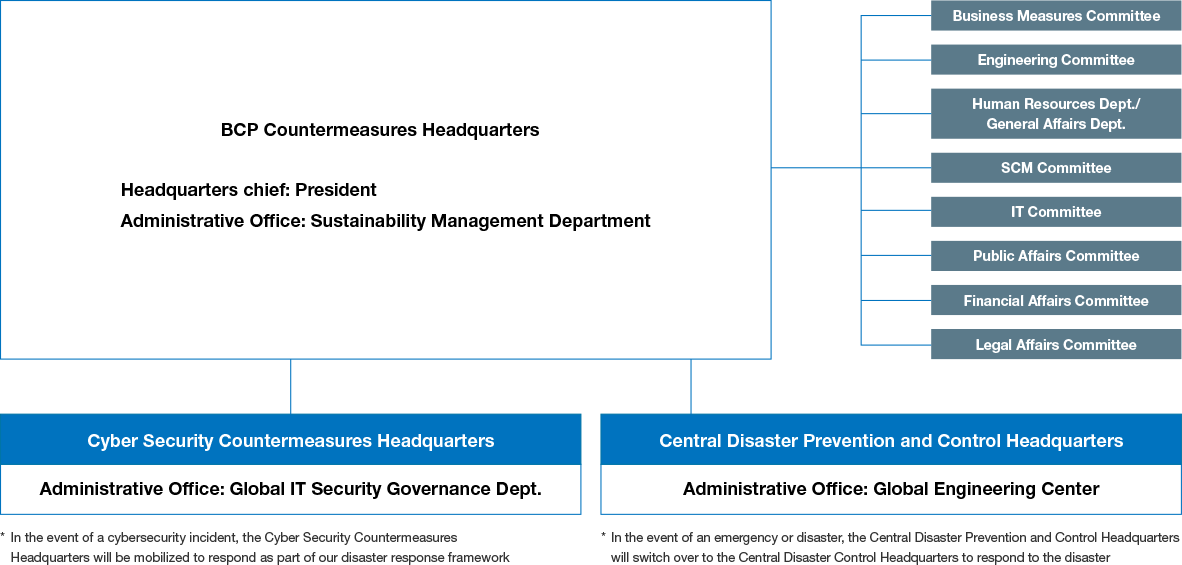
BCP Organizational Structure
This diagram shows our Business Continuity Plan, or BCP. The BCP Countermeasures Headquarters, led by the President, directs the Central Disaster Prevention and Control Headquarters and various committees.

FY2024 Initiatives

EducationThis is a pictogram depicting Education.
  • Conduct regular lifesaving seminars
AwarenessThis is a pictogram depicting Awareness.
  • Send out newsletters related to fire prevention and disaster preparedness
TrainingThis is a pictogram depicting Training.
  • Conduct highly effective training through both face-to-face and online training sessions
OtherThis is a pictogram depicting Other initiatives.
  • Revised the action plan based on insights gleaned from the prior fiscal year’s practical BCP activities

Future Initiatives

  • Improve the effectiveness of BCP by raising the level of training further (e.g., hold BCP training for operational units)
  • Ongoing support for home disaster prevention initiatives (dealing with those who are unable to return home after a disaster and providing drills for returning home in an emergency, etc.) from the perspective of respect for human life, which is the top priority of BCP
  • Continue to hold education, training, and disaster preparedness events with the aim of improving the BCP/disaster prevention awareness of each and every employee