
Sustainability Management
Approach and Policy
NGK Group Basic Sustainability Policy
1. Basic Approach
By providing new value through our unique ceramic technologies under the NGK Group Philosophy of "Enriching Human Life by Adding New Value to Society," NGK Corporation and its Group companies (hereinafter, the ”NGK Group”) hope to contribute to the achievement of a sustainable society and earn the trust of society by meeting its expectations toward us. Setting this as the NGK Group's basic approach to sustainability, and keeping Environment, Society, and Governance (ESG) and the Sustainable Development Goals (SDGs) at the forefront in realizing the NGK Group Philosophy, we aim to contribute to the achievement of carbon neutrality and a digital society as we continuously enhance our corporate value.
2. Identification of material issues (Materiality) and promotion of initiatives
For the realization of the NGK Group Philosophy and for the sustainable advancement of society and the NGK Group, we will identify material issues faced by the NGK Group and our stakeholders as Materiality, and will address these in accordance with the NGK Group Code of Conduct as a guideline for our actions.
3. Responsibilities of the Board of Directors
The Board of Directors seeks to correctly recognize the ESG factors and other sustainability issues of the NGK Group and to connect these to the enhancement of our medium- to long-term corporate value by appropriately supervising and addressing initiatives aimed at sustainability issues. The Board of Directors also engages in appropriate disclosure of information and, based on insights gained through valuable dialogue with diverse stakeholders, strives to improve our management and to live up to the trust and expectations of society.
April 2023 Resolution of the NGK Insulators, Ltd. Board of Directors
[Company Name (Trade Name) to Change to NGK Corporation in April 2026]
Governance
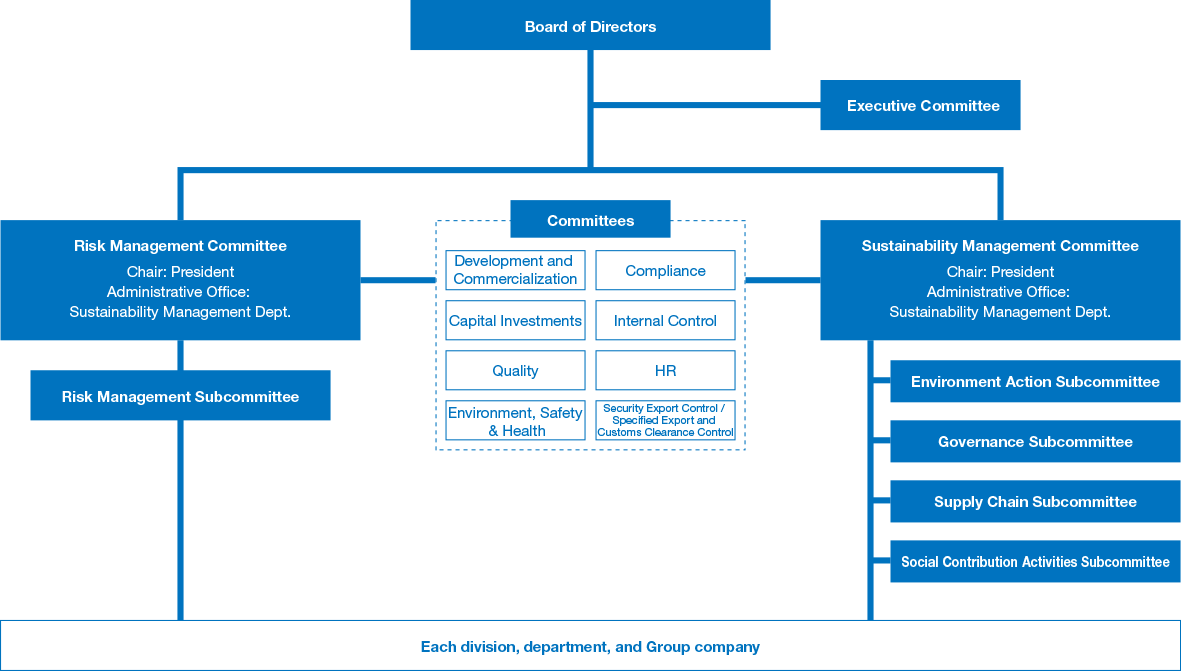
Risks and opportunities related to the NGK Group’s sustainability issues, including ESG factors, are consolidated and reviewed by the Sustainability Management Committee. The committee’s activities are reported to the Board of Directors at least once a year. Matters requiring action are deliberated or reported to the Executive Committee and the Board of Directors, and then implemented as measures.
The Risk Management Committee formulates policies related to risk management, establishes the necessary framework, and monitors implementation. Individual risks are managed by relevant committees and other bodies.
The President chairs both the Sustainability Management Committee and the Risk Management Committee. Members include executive officers and division heads responsible for corporate and business divisions.
| Times | Topics of discussion |
|---|---|
| 1st (May 2025) |
|
| 2nd (July 2025) |
|
| 3rd (September 2025) |
|
| 4th (December 2025) |
|
| 5th (February 2026) |
|
Risk Management
The NGK Group identifies and addresses key sustainability-related risks and opportunities by designating the most important issues as materiality items through deliberations by the Management Council and the Board of Directors.
We first evaluated a broad range of environmental and social issues that could become materiality candidates using two criteria: their impact on the business and stakeholder requests and expectations. Based on this assessment, we developed a materiality map. The ESG Management Committee then identified materiality candidates and examined the associated risks, opportunities, and key initiatives. After these discussions, the Management Council and the Board of Directors approved the final materiality items.
Strategy, Metrics and Targets
The NGK Group has established KPIs for all identified materiality items and is advancing initiatives to achieve them.
Sustainability Activity Priority Themes
Based on the NGK Group Basic Sustainability Policy, the NGK Group promotes environmental and social initiatives aligned with its identified materiality items. We also strengthen the effectiveness of governance as the foundation of value creation and strive to achieve sustainable growth.
| Materiality | |
|---|---|
| E (Environmental) |
|
| S (Social) |
|
| Foundation of Value Creation (Governance) | |
| G (Governance) |
|
Initiatives
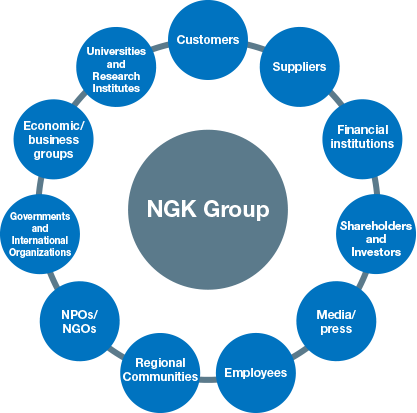
NGK Group Signs UN Global Compact
NGK Group has signed the United Nations Global Compact, a voluntary corporate initiative proposed by the United Nations, and advances its business activities using the Sustainable Development Goals (SDGs) as a key framework. Through these efforts, we recognize it as an important responsibility to help address a wide range of social issues.
Position on SDGs
NGK Group operates businesses in the fields of energy, ecology, and electronics. We have helped protect clean air and water and contributed to more comfortable lives. Today, we continue to leverage our unique ceramic technologies to provide products and technologies that support the Sustainable Development Goals (SDGs) and create new value for the realization of a sustainable society.

| Goals | Value provided by the NGK Group | |
|---|---|---|

|
End poverty in all its forms everywhere |
|
|
End hunger, achieve food security and improved nutrition, and promote sustainable agriculture |
|
|
Ensure healthy lives and promote well-being for all at all ages |
|
|
Ensure inclusive and equitable quality education and promote lifelong learning opportunities for all |
|
|
Achieve gender equality and empower all women and girls |
|
|
Ensure availability and sustainable management of water and sanitation for all |
|
|
Ensure access to affordable, reliable, sustainable, and modern energy for all |
|
|
Promote sustained, inclusive and sustainable economic growth, full and productive employment, and decent work for all |
|
|
Build resilient infrastructure, promote inclusive and sustainable industrialization, and foster innovation |
|
|
Reduce inequality within and among countries |
|
|
Make cities and human settlements inclusive, safe, resilient, and sustainable |
|
|
Ensure sustainable consumption and production patterns |
|
|
Take urgent action to combat climate change and its impacts |
|
|
Conserve and sustainably use the oceans, seas, and marine resources for sustainable development |
|
|
Protect, restore and promote sustainable use of terrestrial ecosystems, sustainably manage forests, combat desertification, and halt and reverse land degradation and halt biodiversity loss |
|
|
Promote peaceful and inclusive societies for sustainable development, provide access to justice for all, and build effective, accountable and inclusive institutions at all levels |
|
|
Strengthen the means of implementation and revitalize the global partnership for sustainable development |
|