
Pursuit of Quality and Product Safety
Approach and Policy
The NGK Group positions quality and product safety as one of its material issues. Starting from the customer’s perspective, we see it as our mission to continuously provide safe, reliable, and trusted products and services. By properly managing risks related to quality and product safety, we aim to contribute to the sustainable development of society. Based on this approach, we have established mechanisms to ensure quality throughout the product lifecycle and continue improvement activities under a governance framework involving senior management.
NGK is dedicated to quality and committed to providing valuable products and services that are trusted by our customers and respected by society
Promotion Framework
Based on the view that quality is the foundation of business activities, the NGK Group has established a Group-wide, integrated quality governance framework. By combining a Group-wide management structure overseen by the Quality Committee Chair with operating structures within each business group led by the heads of those groups, we identify and manage quality risks at both the management and frontline levels.
Group-wide Quality Management Framework
The Quality Committee Chair regularly reports on the status of the following activities to the Board of Directors, ensuring alignment with management oversight.
Quality Committee
The Quality Committee meets at least twice a year. It reviews progress in management indicators such as quality costs on a semiannual basis and deliberates on serious matters related to quality and product safety that require management decisions.
Quality Review Meeting
For serious cases, we bring together in-house expertise to examine reliability, safety, and other aspects from multiple perspectives. We then provide recommendations and guidance for corrective action and support the implementation of measures to prevent recurrence and drive improvement.
Quality Activity Meetings
The meeting monitors product-specific market defects, manufacturing yield, and the status of company-wide improvement activities, and discusses any actions required.
QuiC Steering Meeting
The QuiC Steering Meeting reviews and deliberates on matters necessary to promote improvement activities (QuiC activities).
Activity Systems Within Each Business Division
Within each business division, we have established quality management systems tailored to the characteristics of each business line and promote quality activities accordingly. For each product line, we set the indicators needed to ensure the quality and safety of our products and services. The Quality Committee for each product line meets at least twice a year to review progress and decide on the actions needed for improvement. Each business group serves as the point of contact with customers and works to further increase customer satisfaction by reflecting market quality issues and customer requests in our products and services.

ISO 9001 and IATF 16949 Certification Status (As of August 2026)
NGK Group has obtained either IATF 16949 or ISO 9001 certification, depending on the product, across all business groups, including headquarters, as well as at production sites of Group companies in Japan and overseas and related supporting functions.
Automotive-related products are certified to IATF 16949, while other products are certified to ISO 9001. By undergoing annual audits, we maintain a system that ensures the quality and safety of our products and services.
In addition, each business division conducts an internal audit once a year based on its own quality management system. We also verify the effectiveness of these systems through product-specific quality audits conducted by customers and other parties.
The Group-wide certification rate is 100%, with the breakdown shown below.
| IATF16949 | ISO9001 | Total | |
|---|---|---|---|
| Sites Covered by Certification (No. of sites) | 14 | 25 | 39 |
| Certified Sites (No. of sites) | 14 | 25 | 39 |
Metrics and Targets
Quality Objectives
At the NGK Group, we set Quality Objectives each fiscal year based on our Quality Policy to improve the quality of our products and services and ensure safety. In FY2025, to reliably keep our promises to customers, we promoted initiatives under the objective of having everyone from management to frontline workers thoroughly discuss and improve overburden, waste, and unevenness—in our operations, with the aim of improving the quality of our operations and our organizational culture. As a result, quality compliance is gradually taking root as part of day-to-day activities in each department, and people on the front lines are increasingly sharing candid views and insights. In FY2026, to make these results more tangible, we will continue our efforts to improve the quality of our operations and our organizational culture without losing momentum. In addition, we set a new objective that incorporates a perspective that values how products and services will be used in the market and what customers will expect from them, so that we can deliver the value customers seek from new products and services that will be commercialized in the future.
Improve overburden, waste, and unevenness in our operations, and meet customer expectations by considering how our products and services will be used.
KPI
The NGK Group has set the number of serious incidents involving products and services as a KPI and manages it with an annual target of zero. Each fiscal year, the Risk Management Committee and the Quality Committee review this KPI and determine any actions needed for improvement. In FY2025, the Group recorded zero serious incidents.
Customer Satisfaction Survey
To reflect customer feedback in our products and services, each business group establishes its own survey methods and works to improve customer satisfaction.
| 2021 | 2022 | 2023 | 2024 | 2025 |
|---|---|---|---|---|
| 100% | 100% | 100% | 100% | 100% |
- *Calculation method
Participants were asked to respond to survey questions by providing a rating from one to ten, with responses of six or higher counted as “Satisfied”
The customers included in this survey account for 45% of total sales
Initiatives
Under its Quality Policy, the NGK Group is focusing on the five priorities shown in the table below as the core of its Activities to Increase Customer Trust. We believe that meeting customer expectations helps build trust.
| Item | Initiatives |
|---|---|
| 1. Quality Compliance |
|
| 2. Reducing Quality Risks in Products and Services |
|
| 3. Responses to Quality Issues |
|
| 4. Activities to Improve Employees’ Quality Awareness and Knowledge |
|
| 5. Communicating with Customers |
|
Quality Compliance
Quality of operations Improvement Activities
The NGK Group defines quality of operations as the quality of work needed to fulfill promises made to customers. Based on its company-wide quality compliance program, the Group has continued to establish rules and regulations, provide training, conduct audits and monitoring, and carry out preventive activities. Through executive lectures and the distribution of educational videos, NGK has worked to raise awareness of quality compliance as a personal responsibility at every level, from directors and management to frontline workers. Building on these efforts, NGK is now creating a framework that enables each department to improve quality of operations with greater independence.
Reducing Quality Risks in Products and Services
Through the following activities to reduce product and service quality risks, NGK works to prevent serious customer complaints before they arise and to reduce the likelihood of product recalls, compensation costs, and reputational damage.
Formulating and Embedding Quality Activity Rules
To reduce quality risks in the market, NGK has formulated company-wide Quality Activity Rules and is working to embed them in operations and improve their effectiveness.
Quality confirmation rule
Establish milestones, from development to start of production, and confirm conformance with quality items when production processes change.
DR function strengthening rule
Register DR plans with quality risks of medium or high level as important DR subjects with participation of company-wide DR reviewers. The General Manager of the Corporate Quality Management Dept. holds company-wide DRs for cases with a particularly high risk level.
Quality monitoring rule
Monitor and share information company-wide with respect to quality status changes or problems concerning manufacturing or markets. Manufacturing defects and customer complaints are shared company-wide every month through reports to the Corporate Quality Management Dept., and the appropriateness of countermeasures is discussed.
Rule for handling major customer complaints
In the event of a serious customer complaint, including a potential complaint, the situation is promptly reported to the Quality Committee Chair to formulate company-wide countermeasures.
QRE-P Activities
NGK promotes QRE-P Activities company-wide as an operational process to eliminate quality risks before they arise across the entire commercialization process, from product and service planning to mass production.
QRE-P Activities focus on how work is carried out, as this can lead to market defects. By analyzing these issues with each division and making improvements, NGK works to improve quality and prevent recurrence.
In fiscal 2025, NGK implemented the following initiatives to improve the effectiveness of QRE-P Activities.
- In the analysis of market defects, NGK narrowed the scope of priority guidance to selected divisions, chose four cases, and shared operational process improvements with those divisions.
- In new business development, NGK worked with development divisions on initiatives to eliminate quality risks, centered on the preparation of QFD (Quality Function Deployment).
- NGK formulated guidelines for two areas: activities that focus on customer experience and delivered value from the customer’s perspective, and product safety activities based on ISO/IEC Guide 51.
In FY2026, building on these efforts, NGK will work to further embed and advance QRE-P Activities.
- Continue focused guidance in defect analysis to improve the effectiveness of operational process improvements.
- Build a mechanism for sharing development status in new business development, centered on QFD.
- For initiatives focused on customer experience and delivered value from the customer’s perspective, raise awareness of the guidelines and verify cases through practical support for new business projects.
- Continue efforts to improve the safety of products and services through QRE-P Activities.
Activities to Strengthen Design Review (DR) Functions
The NGK Group positions Design Review (DR) as one of its most important activities and conducts DRs at key milestones in development and when changes are made to manufacturing processes.
For critical DRs, reviewers from across the Company participate to strengthen efforts to eliminate quality risks.
To further enhance discussions in DRs and ensure the thorough elimination of quality risks, we have established the DR Guidelines and improve their effectiveness through training and post-review evaluations of each DR.
In addition, when issues are difficult to resolve within individual departments, the Company holds company-wide DRs (company-wide quality review meetings). These bring together engineers and experts from across the organization to conduct multi-faceted evaluations of product reliability and safety.

Safety Risk Assessments for Products and Services
The NGK Group implements the following key initiatives to assess safety risks in products and services.
- The Group positions product and service safety as one of the key quality requirements within its quality confirmation rules and has established a framework to implement and verify this through QRE-P activities. In addition, we have developed company-wide safety guidelines based on ISO/IEC Guide 51, which serve as guiding principles for business and development divisions.
- In product development, safety is reviewed in DRs based on the requirements of IATF 16949, ISO 9001, and IEC QC 080000. Risks and system deficiencies are corrected through annual certification renewals, as well as internal and external audits. The Quality Management Department supports and verifies risk assessments by participating in DRs and holding quality assurance review meetings for new products.
- In the event of emergencies or incidents, we maintain a system that enables prompt response in accordance with our crisis management regulations. Even after product shipment, we implement corrective actions related to safety through customer satisfaction surveys, market monitoring, and periodic recalls.
Responses to Quality Issues
The NGK Group has established systems to respond promptly and appropriately when issues related to the quality or safety of its products and services arise.
In the event of a serious market complaint, or when there is a risk of such a complaint, we follow the “Rules for Handling Serious Market Complaints,” one of its quality activity rules. Under these rules, the issue is promptly reported to the Quality Committee Chair, and company-wide measures are considered.
For quality issues that may have a significant impact on the Company, a response framework is established in accordance with the crisis management regulations.
When a problem occurs, we investigate the root cause in parallel with emergency response measures and works to prevent recurrence by improving product design and manufacturing processes.
The crisis management regulations are reviewed annually and revised as necessary to ensure that optimal quality and safety management systems are maintained.
Responses to Quality Issues
QuiC Activities
The NGK Group has promoted company-wide quality improvement activities involving all employees under the name “QuiC Activities” since fiscal 2003.
Outstanding improvement examples from QC circle activities and suggestion programs are shared across all Group companies and are horizontally deployed at the annual Company-wide QuiC Activities Contest.
In addition, we have been continuously promoting the “NGK-BOX / Surprising Challenges!” initiative since FY2021. This initiative aims to enhance employee motivation and revitalize workplaces by sharing reform examples and best practices across the Company.
In FY2025, we held “NGK Days” for the first time, a combined event in which administrative and indirect divisions presented challenges in their operations and delivered interactive, participatory content. Through employee interaction, the event encouraged new challenges and co-creation.


External Presentations of Improvement Case Studies
The NGK Group shares case studies obtained through its quality improvement activities with external stakeholders and leverages them to enhance future initiatives.
In FY2025, the Group presented case studies at three events: the Chubu Quality Control Conference QC Circle Case Study Presentation Meeting, organized by the Chubu Quality Control Association; the International Conference on Quality (ICQ 2025), organized by the Union of Japanese Scientists and Engineers; and the Foreman Conference, organized by the Japan Management Association.
Activities to Improve Employees’ Quality Awareness and Knowledge
Education on Quality and Safety
The NGK Group provides training programs for all employees to enhance their quality skills.
Basic quality knowledge is delivered through video-based learning, enabling employees to learn anytime, anywhere, and repeatedly.
In addition, we offer both online and in-person training programs on practical topics such as statistical quality control, root cause analysis (the “Five Whys”), and product safety.
| Training name | Number of Sessions | Purpose and Features |
|---|---|---|
| Individual Training | Fifteen Times a Year |
|
| QC Methodology Practice | Nine Times a Year |
|
| SQC(Statistic Quality Control) Methods Seminar |
Seven Times a Year |
|
| Why-Why Analysis | Once a Year |
|
| Reliability Basics Training | Reliability Basics Training 1: Once a Year |
|
| Reliability Basics Training 2: Once a Year |
|
|
| QMS Training | ISO/IATF standards interpretation: Eight Times a Year |
|
| ISO/IATF Internal Quality Auditor training: Ten Times a Year |
|
|
| VDA 6.3 Process Auditing Seminar: Twice a Year |
|
|
| Product Safety Training | Three Times a Year |
|
Education on Lessons Learned from Past Mistakes
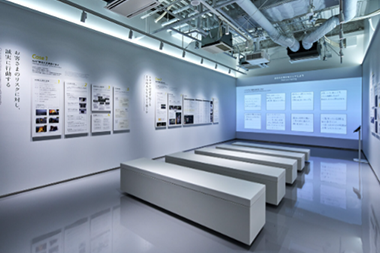
The NGK Group has established a dedicated learning theater at “NGK Collaboration Square DIVERS,” which opened in July 2025. This facility enables each employee to learn from past failures, internalize them as personal experiences, and translate the lessons into future actions.
At the theater, employees confront past serious incidents, including inspection irregularities related to insulators, and learn key lessons that all employees should understand through highly immersive video content. Employees also share their reflections by leaving messages, helping to pass on these lessons across the organization.
Communicating with Customers
Communicating with Customers
The NGK Group discloses information required by society accurately and promptly based on the NGK Group Corporate Business Principles and Code of Conduct.
Regarding product information, the Group provides clear explanations on product features and handling precautions on its website and offers safety information tailored to individual customer cases. The Group also continuously strengthens its systems for providing product safety information.
In product development, the NGK Group confirms and complies with regulations in the countries and regions where products are shipped, and thoroughly implements safe design in accordance with those requirements.
For customers, the Quality Assurance function takes a central role in responding to requests for chemical substance surveys and provides related information, including Material Safety Data Sheets (MSDS).
Furthermore, based on the NGK Group Environmental Policy and the NGK Group Supplier Code of Conduct, the Group works with its business partners to ensure product and service safety, prioritize procurement of environmentally friendly materials, components, and equipment, and appropriately manage chemical substances contained in products.