Initiatives Toward Carbon Neutrality
Approach
Climate change is a global challenge that has serious impacts on the environment as well as on society and the economy. In response, initiatives toward carbon neutrality are being advanced worldwide under international frameworks such as the Paris Agreement.
The NGK Group positions climate change as one of its materialities. We are promoting initiatives toward carbon neutrality across our entire value chain. We support the recommendations of the Task Force on Climate-related Financial Disclosures (TCFD) and identify risks and opportunities associated with the transition to a carbon-neutral society based on those recommendations.
In response to these societal expectations, our materialities, and relevant laws, regulations, and policies in each country and region, we formulated the NGK Group Environmental Vision in 2021. Under this vision, we regard global environmental conservation as a critical challenge shared by all humanity. Through our business activities, we are committed to contributing to the realization of Carbon Neutrality, a recycling-oriented society, and harmony with nature.
Strategy and Approach, Indicators and Targets
The NGK Group is advancing initiatives under the NGK Group Environmental Vision based on the Carbon Neutrality Strategic Roadmap and the 5-Year Environmental Action Plan.
In the area of Carbon Neutrality, we are working toward realizing net zero CO2 emissions in our own activities by 2050. To achieve this goal, we are developing products and technologies that contribute to reducing environmental impacts while promoting initiatives to reduce GHG emissions across our value chain.
Specifically, we have established the following targets for 2050.
Scope 1 and 2*emissions: Net zero by FY2050
Scope 3*emissions: Reduction of more than 90% by FY2050 (Reference Year: FY2022)
- *Scope 1: Direct emissions from our own operations
- *Scope 2: Indirect emissions from the use of purchased energy
- *Scope 3: Emissions across the entire value chain, excluding Scope 1 and 2
We have established these long-term targets in line with the approach of the Science Based Targets initiative (SBTi). Based on the Carbon Neutrality Strategic Roadmap, we are promoting the development of products and technologies that contribute to the realization of a carbon-neutral society, as well as initiatives to reduce Scope 1 and 2 emissions. Through these efforts, we aim to mitigate transition risks and expand business opportunities.
Targets and Results Based on the 5-Year Environmental Action Plan
Scope 1 and 2 Emissions
The NGK Group is promoting energy conservation measures, including the installation of solar power generation facilities and the procurement of renewable energy. As a result of these initiatives, Scope 1 and 2 emissions totaled 390,000 metric tons in FY2025, achieving our target of 500,000 metric tons or less. We will continue to strengthen these initiatives and pursue our 2030 milestone target.

- *The numerical values in the graph include the effect of carbon neutral LNG. Carbon neutral LNG is LNG that has been offset with CO2 credits and is considered to generate no CO2
Scope 3 Emissions
The NGK Group began tracking Scope 3 emissions for NGK on a standalone basis in FY2019 and expanded its calculations to cover the entire Group in FY2022. In FY2025, Scope 3 emissions totaled 4.20 million metric tons.
Category 1, Purchased Goods and Services, and Category 11, Use of Sold Products, account for the majority of Scope 3 emissions. We have identified these categories as priority categories and are working with suppliers and customers across the value chain to reduce emissions. As a first step, we are prioritizing efforts to achieve our FY2030 reduction target.

Promotion Framework
Framework for Reducing Scope 1, 2 and 3 Emissions
The NGK Group has established a framework to reduce Scope 1, 2 and 3 emissions as part of its efforts to achieve Carbon Neutrality. Based on the Carbon Neutrality Strategic Roadmap and an approach that encompasses the entire value chain, we steadily implement measures in line with roadmaps developed for each key theme.
In carrying out these initiatives, we ensure appropriate management and operation in accordance with climate change, energy use, and other relevant laws, regulations, and policies applicable to our sites in Japan and overseas. In Japan, we comply with the Act on Promotion of Global Warming Countermeasures and the Act on the Rational Use of Energy.
We will continue to promote initiatives to reduce Scope 1, 2 and 3 emissions through company-wide collaboration.

Initiatives
Initiatives in Line with the Carbon Neutrality Strategic Roadmap
Strategy 1: Development and Provision of Carbon Neutrality-related Products/Services
The NGK Group envisions the transition to a decarbonized society progressing through three phases: “Reduce” (through 2030), “Change” (through 2040), and “Eliminate” (from 2040 onward). We will continue to contribute to solving social issues by providing solutions that are chosen by markets and customers through both products and manufacturing technologies and services and value creation.
Leveraging NGK’s core technologies in adsorption, separation, and synthesis, we are advancing product development and demonstration testing. In addition to establishing core technologies, we aim to build solutions that help address social issues.
During the “Reduce” phase through 2030, we will meet demand for emissions reductions through energy conservation by utilizing dehydration membrane and separation membrane technologies. In the “Change” phase through 2040, we anticipate a shift toward alternative fuels driven by tighter regulations and rising carbon pricing, and we will promote the application of DAC and reactor technologies.
In the “Eliminate” phase from 2040 onward, we will continue development and related initiatives based on a backcasting approach, looking ahead to a transition to fusion power generation, one of the carbon-free energy sources of the future.

Strategy 2: Top-Down Enhancement of Energy Conservation
Energy Conservation at Production Sites
The NGK Group positions the promotion of energy conservation as its highest priority for reducing Scope 1 and 2 emissions. We are implementing a wide range of measures with a target of improving energy consumption intensity by 2% annually, exceeding the 1% annual improvement target set under the Act on the Rational Use of Energy and Shift to Non-fossil Energy.
Led by the heads of manufacturing divisions, we hold Energy Conservation Promotion Meetings twice a year to share progress across divisions and identify opportunities for further improvement. In addition, our corporate manufacturing engineering division conducts energy conservation patrols that provide assessments and guidance to support the introduction of energy conservation measures tailored to the characteristics of each division.
Through these initiatives, we reduced Scope 1 and 2 emissions across the Group by approximately 13,000 metric tons, equivalent to about 3%, in FY2025. The cumulative reduction achieved over the five years since FY2021 has reached approximately 100,000 metric tons. We will continue to drive continuous improvement based on the targets established by each division.
- Increase in Efficiency of Manufacturing Processes
By converting fuel to natural gas and upgrading kiln linings and burners to more efficient models, NGK has reduced CO2 emissions from its Continuous Kilns by approximately 70% compared with levels in the 1980s and continues to maintain and improve this performance. In recent years, we have further promoted energy conservation and operational efficiency through measures such as optimizing the air-fuel ratio during firing and utilizing waste heat from drying furnaces and other facilities.
Reduction of CO2 Emissions Intensity from Continuous Kilns by Year of Introduction
- *Changes in per unit of CO2 emissions from continuous kilns, a typical production facility
- Energy Conservation Grand Prize Winner (FY2024)
NGK ADREC, a member of the NGK Group, received the Director-General's Award of the Agency for Natural Resources and Energy (Industrial Sector) in the Energy Conservation Case Studies Category at the FY2024 Energy Conservation Grand Prize, organized by the Energy Conservation Center, Japan.
The award recognized NGK ADREC’s efforts to enhance energy conservation through initiatives launched following energy conservation patrols and assessments. These initiatives included reviewing operating conditions and consolidating facilities to improve energy conservation performance.
We plan to expand these initiatives to other sites and further promote energy conservation.
Energy Conservation in Offices and Back-Office Departments
- Construction of a Zero Energy Building (ZEB)-orientated Office Facility
The NGK Group actively promotes energy conservation when constructing new buildings and renovating existing facilities. At the new administration/welfare wing in the Mizuho area of our Nagoya Operations, we introduced high-efficiency equipment and renewable energy, while also leveraging site-specific features such as the use of low-temperature waste heat from an adjacent plant, natural ventilation, and daylighting.
As a result, we achieved an approximately 50% reduction in GHG emissions compared with the emissions projected from the reference primary energy consumption calculated based on the total floor area and operating hours of the Mizuho E1 Building.
This project was selected for the Leading Sustainable Building Project (CO2 Reduction) sponsored by the Ministry of Land, Infrastructure, Transport and Tourism, and achieved ZEB-Ready certification in FY2022. In FY2023, it also received the Director-General's Award of the Agency for Natural Resources and Energy (Business Category) at the Energy Conservation Grand Prize.
The new administration/welfare wing in Mizuho, Nagoya Energy-Efficient Design and Operation of the Office and Welfare Buildings in the Mizuho Area, Nagoya Works
In addition, NGK Collaboration Square DIVRES, a Co-Creation Center that opened in July 2025, has achieved ZEB (zero energy building) status through a high level of energy conservation and the use of renewable energy. Improvements to the building envelope and the installation of high-efficiency equipment have significantly reduced energy consumption. Combined with energy generated by photovoltaic power generation systems, these measures have enabled virtually zero primary energy consumption.
In particular, the environmental facade* is a key feature that combines an open architectural design with reduced environmental impact. High-insulation glass minimizes heat loss from indoor spaces. In addition, the inclined exterior design on the south side effectively blocks solar radiation during summer while maintaining natural daylight and outside views. External louvers installed from the east to southeast sides further reduce peak solar radiation and help lower air-conditioning loads.
These architectural features reduce energy consumption while maintaining a comfortable indoor environment and support the achievement of ZEB performance.- *environmental facade: A facade design that enhances building environmental performance through heat shielding, thermal insulation, solar control, and natural ventilation.

NGK Collaboration Square DIVERS, a Co-Creation Center - Operation of Existing Buildings
The NGK Group promotes energy conservation not only when constructing or renovating buildings, but also in existing office buildings and workplaces. More than 30 years have passed since the headquarters main building was completed, and there is room to improve its energy conservation performance compared with newer facilities. To address this issue, we have launched new initiatives to achieve further energy conservation effects, in addition to our conventional management methods.
As a specific measure, we installed instruments on each floor to display temperature, humidity, and discomfort index readings. We also distributed a video message from top management to employees, encouraging them to take energy conservation actions. In addition, facility managers now finely adjust air-conditioning systems while checking actual measurements from the instruments and appropriately responding to requests from building users.
Through these initiatives, we reduced energy consumption in FY2024 by approximately 20% compared with FY2021. We will continue to improve these activities and expand them to other buildings.
Promoting Investments Toward Carbon Neutrality Across the NGK Group
- Operation of Internal Carbon Pricing (ICP)
The NGK Group introduced internal carbon pricing in FY2022 to promote investment decisions toward Carbon Neutrality. In evaluating capital investments, we use US$140 per metric ton of CO2 as the benchmark carbon price, based on the carbon price for advanced economies in 2030 presented by the International Energy Agency (IEA).
We use internal carbon pricing to evaluate the investment payback of waste heat recovery systems and photovoltaic power generation systems. For some projects, it affected the payback period, one of the key factors in investment decisions, by approximately 30%. Going forward, we will continue to explore additional applications of internal carbon pricing while taking social and market trends into account.
Strategy 3: Promoting Technological Innovation
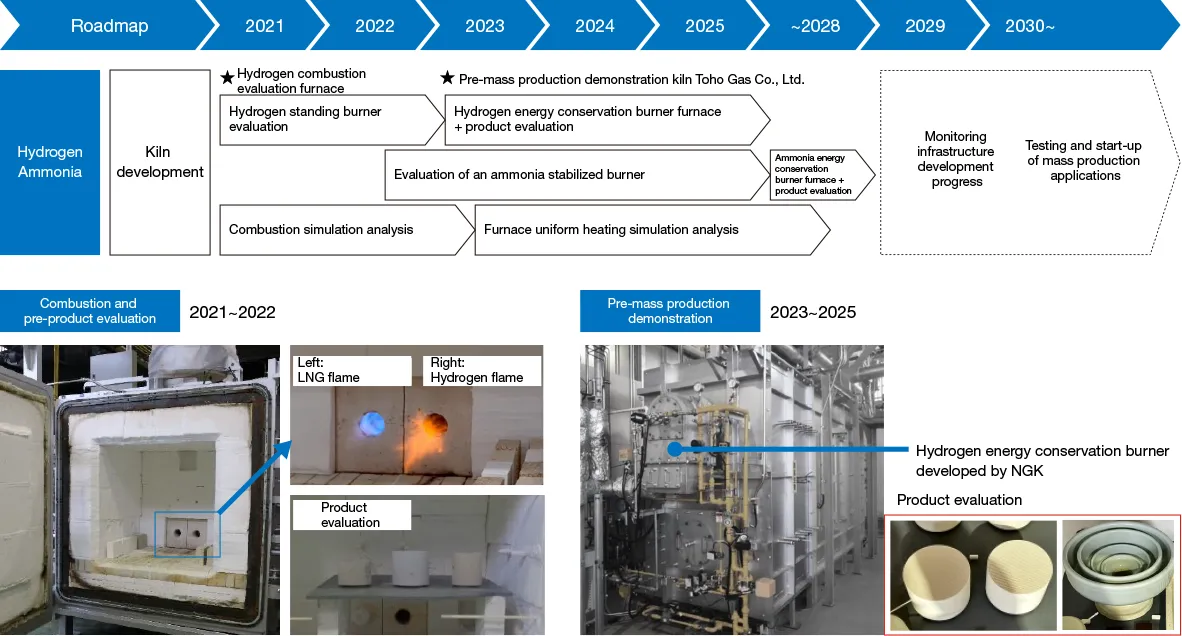
The manufacture of ceramic products by the NGK Group requires a firing process, which primarily uses natural gas as fuel. As a result, reducing Scope 1 emissions is a key challenge in achieving Carbon Neutrality. To address this challenge, we are exploring opportunities for electrification while promoting the development of energy conversion technologies utilizing hydrogen and ammonia.
- Fuel Conversion Technology Development
To support the commercialization of firing kilns equipped with hydrogen burners, we have installed a mass production demonstration kiln and are evaluating its durability and temperature distribution within the kiln. We are also conducting quality verification using prototype products in preparation for commercial applications.
- CO2 Capture Technology Development
With an eye on progress in the development of hydrogen and ammonia infrastructure, the NGK Group is advancing demonstration tests using CCU and CCS (carbon capture, utilization and storage) facilities that capture CO2 from factory exhaust gases. In FY2024, we installed a methanation system that synthesizes methane from captured CO2 and hydrogen. Furthermore, since FY2025, we have been using the methane produced as fuel for deodorizing furnaces and conducting demonstrations of CO2 recycling.

Strategy 4: Expanding Use of Renewable Energy
The NGK Group joined RE100 and has set a target of sourcing 100% of the electricity used in its business activities from renewable energy by 2040 to reduce Scope 2 emissions. To achieve this target, we are systematically expanding the use and procurement of renewable energy while taking cost considerations into account, including the installation of photovoltaic power generation systems and the use of Green Power Certificates. As a result, renewable energy accounted for 50% of our electricity consumption in FY2025.
We will continue to expand the use of renewable energy and advance initiatives to reduce Scope 2 emissions and achieve our target.
- Installation of Photovoltaic Power Generation Systems
The NGK Group is expanding the installation of Photovoltaic Power Generation Systems at production sites in Japan and overseas. We currently operate these systems at sites including NGK Ceramic Device Tajimi and NGK CERAMICS SUZHOU Co., LTD. and have steadily increased our use of renewable energy. We plan to continue installing these systems at additional sites in Japan and overseas.
- Procurement of Renewable Energy
The NGK Group recognizes that promoting energy conservation within the Group and utilizing existing Photovoltaic Power Generation Systems alone will not be sufficient to achieve Carbon Neutrality. Therefore, we procure renewable energy in a planned manner, taking into account regional conditions and costs.
At our overseas sites, we have achieved 100% renewable electricity procurement at all manufacturing sites in Europe. In addition, we began procuring renewable energy at overseas sites outside Europe in FY2025.
Furthermore, NGK Ceramics Polska will begin long-term renewable electricity procurement through a Virtual Power Purchase Agreement (VPPA) in FY2026. This initiative is expected to contribute to a reduction of approximately 940,000 metric tons of CO2 over a 10-year period.
In Japan, we have also started procuring renewable electricity at selected sites. In addition, we have adopted carbon-neutral LNG, which enables environmental value acquisition. These measures are being implemented at our Nagoya, Chita, and Komaki sites, as well as at NGK CERAMIC DEVICE headquarters, helping reduce Scope 1 and Scope 2 emissions.

Initiatives Based on a Value Chain Approach
Promotion of Sustainable Procurement (Reduction of Scope 3 Emissions)
Reducing emissions from Scope 3 Category 1 (Purchased Goods and Services) and Category 11 (Use of Sold Products) requires close collaboration with both suppliers and customers. The NGK Group conducts surveys on GHG emissions and emission reduction targets for approximately 200 key suppliers. Before conducting the surveys, we held briefing sessions to share our climate change policies and initiatives and request their cooperation.
In addition, we deepen mutual understanding and strengthen ongoing collaboration through individual discussions and the exchange of opinions.
We also promote initiatives while considering how we can support suppliers based on their individual circumstances. We contacted approximately 20 suppliers that had not yet begun calculating their emissions and provided guidance on calculation methodologies. Furthermore, we are working with one supplier to identify specific opportunities for emission reductions.

Promoting Carbon Neutrality through Life Cycle Assessments
Life Cycle Assessment (LCA) is a method used to quantitatively assess environmental impacts throughout a product’s entire life cycle. The NGK Group applies LCA to its major products and new products, in addition to tracking Scope 1, 2, and 3 emissions, and is advancing the calculation of carbon footprints (CFP), which represent GHG emissions associated with individual products.
We calculate GHG emissions per product at each stage of the value chain, including raw material procurement, manufacturing, and transportation. By identifying processes with significant environmental impacts, we develop measures to reduce emissions. We also conduct LCA for products in the development stage to support the design of products with lower environmental impacts.
Going forward, we will expand the use of LCA beyond GHG emissions to assess other environmental impacts and use the results to quantify the environmental contributions of our products.
Participation in and Certification with Initiatives and External Organizations
Our Approach to Participation in External Organizations
The NGK Group actively participates in industry associations and initiatives that are aligned with our climate change policies and promotes efforts to achieve net zero CO2 emissions. We regularly review whether the positions and activities of these organizations remain consistent with our policies. If significant differences arise, we consider revising our participation or withdrawing from the organization. These assessments are conducted by the Sustainability Management Department in collaboration with relevant internal departments.
TCFD
The NGK Group endorsed the recommendations of the Task Force on Climate-related Financial Disclosures (TCFD) in 2020. We disclose information based on scenario analysis in line with the TCFD recommendations covering governance, strategy, risk management, and metrics and targets.
We will continue to deepen our analysis, enhance our disclosures, and strengthen dialogue with stakeholders. At the same time, we will clarify the impact of climate change on our business, implement appropriate response strategies, and pursue sustainable growth.

Science Based Targets initiative (SBTi)
The NGK Group obtained validation of its greenhouse gas emissions reduction targets under the Net-Zero Standard from the Science Based Targets initiative (SBTi). Across the entire value chain, we aim to reduce greenhouse gas emissions by 90% or more by 2050 compared with the base year of FY2022.
As an interim target, we aim to reduce Scope 3 emissions by 25% by 2030 compared with the FY2022 level.
RE100
RE100 is a global initiative of companies committed to sourcing 100% of the electricity used in their business activities from renewable energy. The NGK Group joined RE100 in October 2022. Based on the NGK Group Environmental Vision, which targets net zero CO2 emissions by 2050, we are promoting the expanded use of renewable energy as one of our key strategies.
Eco First Program
The NGK Group has been certified as an Eco First company under the Eco First Program, a certification program administered by the Minister of the Environment of Japan.
We recognize environmental protection as a key management priority and continuously pursue initiatives to reduce Scope 1 and Scope 2 emissions while providing environmentally conscious products.
Going forward, through advanced environmental management, we will strive to achieve both a carbon neutral society and sustainable business growth.