
Respecting Human Rights
Approach and Policy
The NGK Group regards respecting human rights across all aspects of its business activities as one of its most important corporate responsibilities. By advancing human rights initiatives throughout our own operations and value chain, we work toward building a society in which the human rights of all people affected by our business activities are upheld.
NGK Group Human Rights Policy
The NGK Group has formulated the NGK Group Human Rights Policy to clearly articulate its commitment to respecting human rights. We communicate this commitment to both internal and external stakeholders and advance our human rights initiatives.
NGK Group Corporate Business Principles and Code of Conduct
To respect human rights in our business activities, the NGK Group has established the NGK Group Corporate Business Principles and Code of Conduct for executives and employees, and the NGK Group Supplier Code of Conduct for suppliers. We advance our initiatives based on these frameworks.
NGK Group Supplier Code of Conduct
The NGK Group respects the human rights of all stakeholders affected by our business activities.
We share this commitment through employee education and training and with all stakeholders, seeking their understanding and cooperation.
With respect to our supply chain in particular, we expect suppliers to comply with our Human Rights Policy and require thorough adherence to the NGK Group Supplier Code of Conduct. This Code of Conduct sets out specific human rights commitments, including prohibition of discrimination, prohibition of forced labor and child labor, ensuring fair wages, and due consideration for working hours.
For key suppliers, we periodically request agreement to comply with this Code of Conduct both upon commencement of new business relationships and on an ongoing basis.
Statement on the UK Modern Slavery Act
The NGK Group publishes its Statement on the UK Modern Slavery Act in accordance with the Act.
Respect for the Human Rights of Children
The NGK Group is aware that there are a variety of impacts that corporations can have on children. In addition to signing the UN Global Compact, we support the Children’s Rights and Business Principles, respect the rights of children through our business activities, and engage in social contribution activities and other efforts to promote children’s rights.
Promotion Framework
The NGK Group has established the Sustainability Management Committee as a cross-functional body to advance human rights-conscious business operations and address human rights issues across the Group. The Committee is chaired by the President and drives human rights initiatives throughout the Group. The Committee is responsible for adopting, revising, and abolishing basic policies on human rights, implementing awareness-raising activities and human rights due diligence for Group companies, and handling grievances and remediation. Material matters decided through the Committee's deliberations are reported to the Board of Directors at least once a year.
Human rights initiatives are driven by the Director responsible for the Sustainability Promotion Department, the Director responsible for the Human Resources Department, the General Manager of the Sustainability Promotion Department, the General Manager of the Human Resources Department, and department heads, each of whom collaborates with relevant committees and departments according to the nature and significance of each matter.


Strategy, Metrics and Targets
Strategy
Guided by the NGK Group Human Rights Policy, NGK Group has established a human rights due diligence framework to identify, prevent, and mitigate any adverse impacts of its business operations on human rights. Where such adverse impacts are confirmed or suspected, we engage in good-faith dialogue with affected parties and pursue appropriate and effective remediation.
Metrics and Targets
Since FY2022, the NGK Group has expanded its self-assessment to cover Group companies outside Japan as well as those in Japan. To date, no incidents of non-compliance with applicable laws have been confirmed. However, certain practices that do not conform to the RBA Code of Conduct have been identified. In response, in FY2024, NGK Insulators, Ltd. (now NGK) revised its work regulations to remove "pay reduction" from the types of disciplinary measures. In FY2025, all Group companies in Japan completed the same revision.
NGK also identifies human rights risks in its business operations and selects priority targets for stakeholder engagement. In FY2025, we conducted an on-site visit to a Group company in Malaysia and held interviews with two HR managers to discuss human rights impacts and related challenges. The findings showed that, within the scope of this assessment, the company is taking various measures to mitigate human rights risks, including initiatives related to occupational safety and health and diversity. While there is room for improvement, no material issues directly linked to human rights risks were identified.
Going forward, we will continue to make improvements with due consideration of the laws, customs, and practices of each country, conduct ongoing monitoring through self-assessments, and take appropriate action as needed.
| Initiatives and Indicators | Targets | FY2025 Results |
|---|---|---|
| Frequency of Two-Way Dialogue with Internal and External Stakeholders | Each FY | Implemented |
| Frequency of Self-Assessments at NGK and Group Companies Based on the RBA Code of Conduct and Similar Standards | Each FY | Implemented |
| Supplier Code of Conduct Sharing: Agreement Rate Among Major Suppliers |
90% or higher | 86% |
| Supplier Assessment Activities: Frequency of Sustainability Surveys Among Major Suppliers |
Every other year | Responses requested* |
| Human Rights Education: Frequency of e-Learning for Executives and All Employees |
Each FY | Implemented |
- *Responses to be compiled in FY2026 (planned)
Initiatives
Human Rights Due Diligence
Human Rights Issues Requiring Our Attention
Guided by the UN Guiding Principles on Business and Human Rights, the NGK Group has developed a long list of fundamental human rights that companies are expected to respect and uses it to identify human rights issues relevant to its operations across the entire value chain. We also conduct surveys on human rights incidents that have emerged in our industry and country risk assessments in the countries where we operate to identify potential human rights risks.
Drawing on these findings, we assessed the priority level of each human rights issue using two criteria, severity and likelihood, in line with the OECD Due Diligence Guidance for Responsible Business Conduct. We also conducted interviews with representatives from each Business Group to organize human rights issues by stakeholder and plot them on a risk map.
Following consultations with relevant parties and reporting to the HR Committee (at the time), we identified the human rights issues to be addressed as a priority. We are now focusing on addressing these issues and working to prevent and remediate adverse human rights impacts.
Going forward, we will continue to review and update our human rights risk map in response to changes in the business environment and feedback from stakeholders.
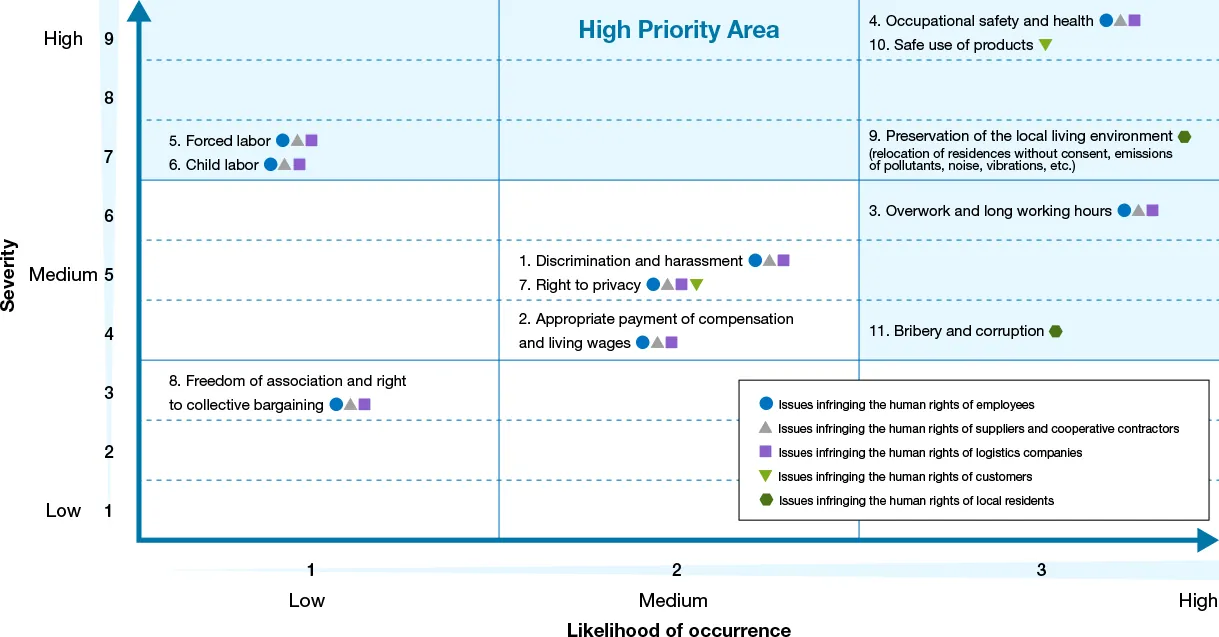
- Overwork and long working hours
- Occupational safety and health
- Forced labor
- Child labor
- Preservation of the local living environment (relocation of residences without consent, emissions of pollutants, noise, vibrations, etc.)
- Safe use of products
- Bribery and corruption
Human Rights Risks Accompanying Group Business Activities
NGK regularly conducts a self-assessment survey based on the RBA Code of Conduct on ourselves and our Group companies in and outside of Japan. In FY2025, a total of 38 companies including NGK underwent the self-assessment survey with a total of 55 questions in the three categories of labor, health and safety, and ethics. Conducting this survey gives us a comprehensive overview of the business activities in our group and identifies human rights issues.
The results confirmed no incidents of non-compliance with applicable laws. However, multiple instances were identified that, while legally compliant, do not conform to the RBA Code of Conduct. In response, in FY2024, we revised our work regulations to remove "pay reduction" from the types of disciplinary measures. In FY2025, all Group companies in Japan completed the same revision.
Human Rights Risks to Employees
Regarding human rights risks related to employees, the NGK Group accepts reports and consultations on human rights through its internal whistleblowing desk. We also receive semi-annual reports from Group companies through the Human Rights Grievance Survey or the Legal Risk Management Report to monitor the situation.
In FY2025, a total of 35 human rights-related reports covering harassment, labor-related matters, and similar issues were submitted across the NGK Group through these mechanisms. For each case, we conduct a fact-finding investigation and take appropriate corrective action, including guidance and awareness-raising.
We also use the Corporate Risk Survey, conducted every two years, to identify potential human rights risks.
Human Rights Risks to Supply Chain
The NGK Group periodically requests major suppliers to agree to comply with the NGK Group Supplier Code of Conduct, both at the commencement of new business relationships and for the continuation of existing ones.
Grievance Mechanisms
NGK has established a whistleblowing desk (helpline) which can be used by everyone who works at NGK, our Group companies in Japan, and each of our sites.
Both internal and external contacts allow for anonymous consultations and reports, and we work to protect those who submit them from retaliation or unfair treatment.
Group companies outside Japan are also building effective whistleblowing mechanisms, including establishing consultation and reporting systems accessible to all individuals at each company, tailored to local conditions.
We have also set up a supplier helpline to handle consultations and reports from suppliers, and we accept consultations and reports from all stakeholders through NGK's website. When we receive a human rights-related consultation or report, the responsible departments and the Sustainability Management Department work with related departments to address the matter. Where human rights impacts are confirmed, we provide remediation for affected parties and implement corrective and recurrence prevention measures.
These matters are reported to the Compliance Committee and the Sustainability Management Committee according to their significance.

Stakeholder Dialogue
The NGK Group identifies human rights risks in its business operations and selects priority targets for stakeholder engagement across its value chain, with the aim of taking appropriate action. In FY2024, based on business conditions and other factors, we conducted interviews with foreign national regular employees and temporary workers at one Group company in Japan. The findings confirmed that the company is working to create a safe and supportive work environment.
The FY2024 country risk assessment also revealed that human rights risks related to migrant workers are a high priority at our Malaysia operations. Recognizing that international guidelines also call for prioritized action on migrant workers, in FY2025 we conducted an on-site visit to a Group company in Malaysia and held interviews with two HR managers to discuss human rights impacts and related challenges. The findings confirmed that, within the scope of this assessment, the company is working to mitigate human rights risks through various initiatives related to occupational safety and health and diversity.
Of the two companies where we have conducted stakeholder engagement to date, while there is room for improvement, no material issues directly linked to human rights risks were identified.

Education and Training
Education Concerning Human Rights
NGK conducts various types of training, through seminars and e-learning, for executives and all employees, with the goal of improving their level of understanding for respecting human rights in our corporate activities.
In FY2025, the e-learning program covered Section 2, "Respecting Human Rights," of the NGK Group Code of Conduct Guidebook. To ensure participants could take the course in a language they can understand, we prepared materials in 13 languages.
| Category | Theme | Participants / Applicable Range | Frequency |
|---|---|---|---|
| Human rights in general | “NGK Group Code of Conduct Guidebook ‘2. Respecting Human Rights’” e-learning program Corporate responsibility to respect human rights, human rights related risks | All officers and employees working at NGK, and our Group companies in and outside Japan (including contract employees, re-hired employees, re-contracted employees, temporary employees, subcontractors, employees seconded from Group companies and part-time employees) | Once a Year |
| Human rights in general | Respect for human rights, NGK’s initiatives, and ESG risks and opportunities | Newly appointed managers, those promoted within managerial positions, career recruits in managerial positions | Once a Year |
| Human rights in general | NGK Group Corporate Business Principles Realization of a sustainable society through business activities, respect for human rights, and thorough compliance |
Employees promoted as those in general positions, career recruits with eligible qualifications, new employees | Once a Year |
| LGBT | “Introduction to LGBT: Aiming for a Worker-friendly Workplace” Basic LGBT knowledge and internal initiatives |
New employees | Once a Year |
| Harassment | Definitions of workplace bullying and sexual harassment, concrete examples, treatment in workplace regulations, helpline introduction, and promotion of understanding through case studies | New employees, employees promoted as those in general positions, and mid-career recruits with the eligible qualifications | Once a Year |
| Harassment | Compliance, workplace bullying and sexual harassment in manufacturing sites | New section chief training | Once a Year |
| Harassment | Lawyer-led seminar “Understanding and techniques for preventing harassment—For better communication—” | Employees of NGK and Group companies in Japan | 5 times a Year |