Occupational Safety and Health
Approach and Policy
The NGK Group operates an ISO 45001-certified occupational health and safety management system based on its Safety and Health Policy as a framework for achieving the safety and health of employees and other workers in an organized and continuous manner. We also thoroughly implement safety measures based on risk assessment. Through these efforts, we continuously improve safety and health standards across the NGK Group, including contractors.
Safety and Health Policy
'Maintaining the safety and health of each employee constitutes a basis for a company's operation and existence'
- 1Comply with Occupational Safety and Health Law and Company Regulations.
- 2Engage in activities in line with the OSHMS* to continuously raise the safety and health standards.
- 3Promote safety and health activities under enough education & training and good communication with employees.
- 4Reduce the risks of hazards and toxicity and prevent accidents to provide a comfortable work environment.
- 5Prevent employees' health hazards and enhance health promoting activities.
- *OSHMS: Occupational Safety and Health Management System
Promotion Framework
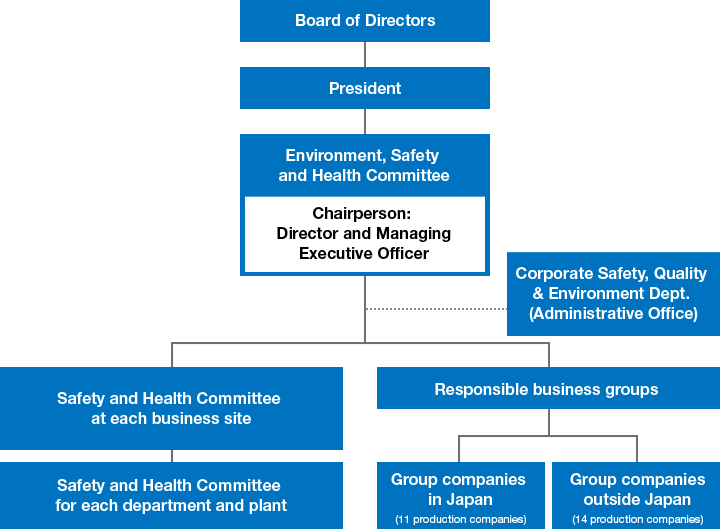
NGK has appointed the Chair of the Environment, Safety & Health Committee as the person responsible for overseeing safety and health in order to enhance safety and health standards across the Group. The Committee is chaired by the Representative Director and Vice President and meets at least twice a year. It deliberates and decides activity policies and action plans and reviews activity results, workplace accidents, and related countermeasures. The Committee reports its activities to the Board of Directors and operates under the Board’s oversight.
In addition, each site holds a monthly Business Site-Specific Safety and Health Committee meeting attended by the General Safety and Health Manager (the site manager or executive officer) and labor representatives from all departments. The committee shares safety and health policies, promotes action plans, and investigates and deliberates site-specific priority issues. The outcomes are communicated throughout each workplace through safety and health committee members.
Strategy, Metrics and Targets
Strategy
The NGK Group carries out its activities in accordance with ISO 45001. To realize the NGK Group Vision, we position achieving and maintaining zero fatal or serious accidents at factories and other sites as our highest priority. We conduct thorough risk assessments of equipment and operations at all sites. When introducing new equipment or changing work processes, we require advance assessments. Where a high risk of serious injury is identified, we implement engineering measures such as equipment upgrades, as well as establish work procedures and provide training for relevant personnel. We also manage these initiatives across our operations, including contractors, and use them to drive continuous improvement.
Metrics and Targets
NGK has set the following numerical targets for 2025.
- Zero fatal or serious accidents throughout the Group
- Group-wide lost-worktime accident severity rate of 0.010 or less
In 2025, we achieved zero fatal or serious accidents throughout the Group. On the other hand, the group-wide lost-worktime accident severity rate climbed to 0.018, failing to meet our target value of 0.010 or less.
FY2025 Results: Work-Related Fatalities and Work-Related Accidents
NGK has set the following numerical targets for FY2026.
- Zero fatal or serious accidents throughout the Group
- Group-wide lost-worktime accident severity rate of 0.010 or less
Initiatives
Enhancing Safety and Health Activities
The NGK Group positions the enhancement of safety and health activities as one of its priority issues. Starting in FY2023, we formulated the third three-year action plan under the overarching policy of "Compliance, Governance, and Risk Reduction." We promote safety and health activities in accordance with the following three activity policies: "Strict compliance with safety and health laws and regulations," "Further strengthening of Group governance," and "Prevention of serious accidents and injuries."
To prevent serious accidents and injuries, we conduct comprehensive risk assessments of existing equipment and operations, and require advance assessments when introducing new equipment or new operations, or when changing existing operations. Through this process, we eliminate risks or reduce them to an acceptable level.
| Medium-Term Action Plan | Fiscal year implementation items |
Key activities |
|---|---|---|
| Compliance | Strengthen mechanisms for compliance with laws and regulations | To ensure strict compliance with safety and health laws and regulations, the NGK Group investigates compliance status and implements corrective measures as needed. We also provide legal training for managers and personnel in charge. To prevent non-compliance such as missed filings, we have developed internal rules and built a filing management database, which is now in operation. |
| Governance | Strengthen safety and health functions in each business group | To strengthen the safety and health functions of each Business Group, the NGK Group clarified the respective roles of the corporate safety and health oversight department and the safety and health departments within each Business Group. We established a framework that enables each Business Group to independently manage and promote safety and health at the plants and Group companies under its responsibility. |
| Risk reduction | Risk Reduction / Serious Accidents / Reducing the Risk of Serious Accidents or Injuries | To address serious accidents and reduce the risk of serious accidents or injuries, the NGK Group comprehensively identified high risks of serious injury related to entanglement in rotating parts, electric shock, and explosion across equipment at all production sites in and outside Japan. We implemented administrative controls and engineering controls through equipment upgrades and modifications. We also continued to provide risk assessment training to improve the accuracy of hazard identification. |
Response to Work-Related Accidents
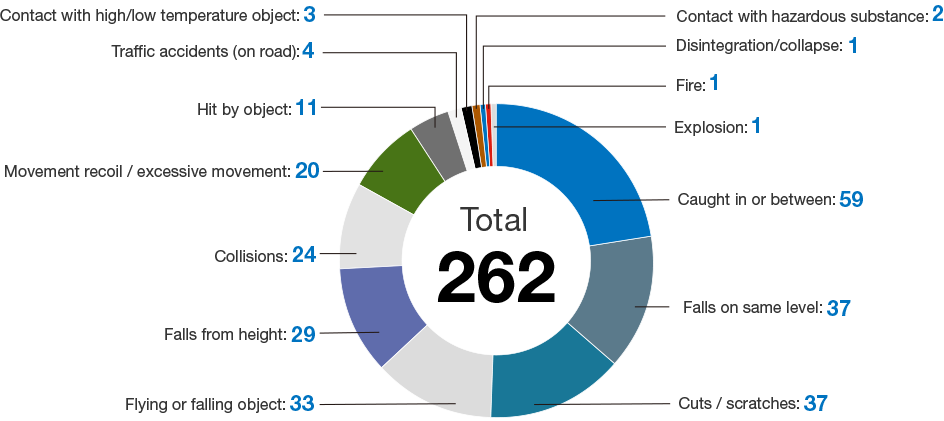
When an accident occurs, the NGK Group promptly notifies the relevant departments and Group companies in accordance with established rules. We convene accident review committees and similar bodies based on each company's regulations to investigate root causes and ensure thorough recurrence prevention measures.
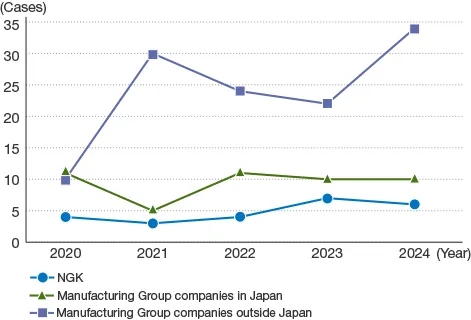
In 2025, the NGK Group recorded 51 recordable accidents (non-lost-time injuries and above) throughout the Group, the same level as the previous year. While minor accidents occurred frequently at manufacturing Group companies outside Japan, three serious work-related accidents resulting in permanent aftereffects also occurred. The main causes were non-compliance with rules and inadequate management of equipment and work methods. Going forward, in addition to existing risk management and equipment measures, we will enforce strict compliance with rules and improve management standards at worksites to strengthen our prevention of serious accidents and injuries.
Number of Contractor Accidents Severe Enough to Result in Lost Worktime
Number of Contractor Deaths
Severity Rate (Number of Lost Workdays per 1,000 Hours Worked)
Lost Time Injury Frequency Rate
Occupational Illness Frequency Rate
External Certification of Occupational Safety and Health Management System
The NGK Group promotes the acquisition of ISO 45001 certification under its occupational health and safety management system to continuously improve workplace safety and health standards.
In FY2017, the NGK Nagoya Site became the first in Japan to obtain ISO 45001 private certification. We currently hold and maintain ISO 45001 and JIS Q 45100 certification at all our sites and plants. All manufacturing Group companies in and outside Japan have also obtained ISO 45001 certification.
Safety and Health Training
In addition to implementing training programs required by safety and health laws and regulations and ensuring that employees obtain the required qualifications, NGK develops voluntary training programs in a systematic manner to raise safety and health standards. In FY2025, 2,296 employees attended internal safety and health training sessions. The main breakdown is as follows: rank-based training and training for newly-promoted employees on safety and health management and work safety rules (644 participants), danger prediction training (1,600 participants), and ISO 45001 internal audit training (52 participants).
| Training programs | Curriculum |
|---|---|
| Statutory training | Safety and health training and skill training courses required under laws and regulations |
| Legal training | Training to understand the overview and requirements of safety and health laws and regulations |
| Hazard identification training | Training to build the ability to identify hazards in work operations and equipment |
| Hazard prediction training | Training to predict dangers in work operations and daily life, and to develop danger awareness and problem-solving skills |
| Danger prediction training | Hands-on simulation training using real accident scenarios to enhance danger awareness |
| Skill certification training | Training to certify workers in specific high-risk operations through skill acquisition and proficiency verification |
| Rank-based and newly-promoted employee training | Training to acquire safety and health management skills and operational safety knowledge required by position and role |
| Frontline management training | Training for senior management, managers, and frontline staff to consolidate safety knowledge and improve worksite judgment and leadership |
| ISO 45001 internal audit training | Training to understand the ISO 45001 management system and acquire the knowledge and methods required for internal audits |
Danger-Prediction Training Center
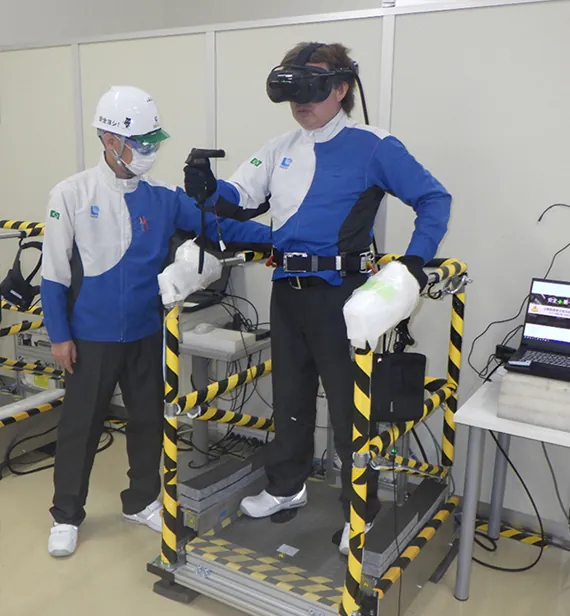
NGK has established a Danger-Prediction Training Center at its Chita Site to prevent work-related accidents. Dedicated instructors deliver hands-on safety simulation education using a combination of equipment that replicates in-house accident scenarios, virtual reality (VR) simulation devices, and computer graphics-based classroom instruction, continuously enriching our simulation education.
In FY2024, we renovated the center and introduced themed zones covering topics such as entanglement, falls, and explosions, while expanding exhibits on actual accident cases for each theme to create a more immersive learning environment. We have also extended these training programs to Group companies in Japan, and the cumulative number of participants through FY2025 has reached 12,509.
Collaborative Safety Activities with Contractors
NGK has established the NGK Safety Cooperation Conference to ensure safety in construction and work operations, promoting collaborative safety activities with contractors.
In selecting contractors, we include safety management as an evaluation criterion and specify safety requirements in contract specifications. We also apply our Safety and Health Policy and related regulations to contractors, ensuring all parties conduct their operations based on a common set of standards.
Activities
Based on our annual activity plan, we conduct safety patrols, safety workshops, and cleaning activities. We also share progress and challenges at monthly meetings, and at our annual safety conference, we work to raise safety awareness and consolidate knowledge through expert lectures and other programs.
Safety Education
We conduct various safety education programs covering topics such as safe work practices in workplaces at risk of dust explosions and the need for lockout/tagout. We also draw on past accident cases to regularly analyze causes and discuss reoccurrence prevention measures.