
Products and Services Contributing to Environmental Protection
Approach
The NGK Group considers contributing to society through its business activities to be an important mission. We leverage technologies we have developed over many years to develop and provide environmentally friendly products and technologies.
Developing and Distributing Products/Services Contributing to Environmental Protection
Based on the fifth 5-Year Environmental Action Plan, the NGK Group has worked to increase registrations of carbon neutrality (CN)-related products and services among its products and services that contribute to environmental protection. We currently have 11 such products and services, four of which are related to Carbon Neutrality.
In FY2025, we newly registered High Porosity Honeyceram.
We will continue to focus on developing new products and providing services, including CO2 separation membranes expected to be used in the CCU/CCS field.
In research and development, we invested approximately JPY 1.28 billion in FY2025 to improve products related to air pollution prevention, and approximately 220 million yen in the development of products related to water resource conservation.
Services Contributing to Environmental Protection

Definition of NGK Group’s Products/Services Contributing to Environmental Protection
We define products and services contributing to environmental protection as those that fulfill any of the following requirements.
- 1Items awarded or certified by third-party organizations
- 2Items helping to reduce and mitigate environmental impact
- 3Items helping to reduce regional environmental impact and address resulting impacts
Development and Creation of Products/Services Contributing to Environmental Protection
Considering Sustainability When Designing Products
The NGK Group promotes the development and adoption of environmentally conscious products and services based on its NGK Group Corporate Business Principles and Environmental Policy.
We regularly verify these initiatives through internal audits conducted under our environmental management system and through third-party audits.
Contributing to Carbon Neutrality
AMB Substrates for Power Modules
(CN-related products)
NGK Group’s AMB substrates for power modules are used in power modules for motor drive control and power conversion control in generators. They efficiently transfer heat generated by semiconductor devices to the cooling system.
Our proprietary bonding technology provides high reliability and excellent heat dissipation performance, enabling power semiconductors to achieve their full performance.
As EV and HEV adoption expands, these products are expected to contribute to Carbon Neutrality through growing automotive applications.

Local Renewable Energy Electric Power Supply Service by ENA ELECTRIC POWER and ABASHIRI ELECTRIC POWER
(CN-related services)
The NGK Group supports local production and consumption of renewable energy to promote Carbon Neutrality in communities.
In Ena City, Gifu Prefecture, we established Ena Electric Power in partnership with the city and Chubu Electric Power Miraiz. We install solar power generation systems and batteries on the roofs of public facilities and on idle land. The electricity generated is supplied to public facilities and NGK Group sites.This initiative contributes to improving local energy self-sufficiency and reducing CO2 emissions.In addition, in Abashiri City, Hokkaido, we supply renewable energy through a similar scheme via Abashiri Electric Power, which we established with the city.
Wavelength Control Drying System
(CN-related services)
NGK’s wavelength control drying system, which uses a proprietary heater unit, improves the efficiency of solvent drying.
By selectively irradiating specific infrared wavelengths, we reduce drying time to about one-half to one-third of that required by conventional thermal drying methods and cut power consumption by 30 to 50 percent.
The system can also suppress concentration unevenness in coating films, known as binder segregation, by 30 to 40 percent.

Preventing Environmental Pollution
HONEYCERAM
HONEYCERAM is a ceramic catalyst carrier used to purify harmful substances in automotive exhaust gases. It stably holds the catalyst and maximizes the contact area with exhaust gas through its honeycomb structure, delivering high purification performance.
While the shift toward EVs is advancing, we expect demand for internal combustion engine vehicles to remain high in the medium term. Reducing harmful substances in exhaust gas will therefore remain important.
HONEYCERAM produced by the NGK Group is currently used in many internal combustion engine vehicles and will continue to support the reduction of environmental impact.

High-Porosity Honeyceram
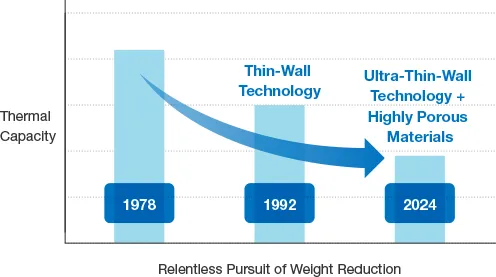
We reduced thermal capacity by making the walls of the honeycomb structure as thin as possible and incorporating numerous micropores within the walls. This enables rapid heating and supports compliance with increasingly stringent exhaust gas regulations through our High-Porosity Honeyceram.
Diesel Particulate Filters (DPFs)
DPFs are porous ceramic filters installed in the exhaust systems of diesel vehicles. They reliably capture particulate matter (PM) through their micropores and purify exhaust gases, making a significant contribution to air pollution prevention.
The NGK Group is the only manufacturer that mass-produces both cordierite and silicon carbide types. We support improvements in the environmental performance of diesel vehicles through our ceramic technologies.


Gasoline Particulate Filters (GPFs)
GPFs are ceramic filters that remove particulate matter (PM) from gasoline engine exhaust gases. Based on diesel particulate filter (DPF) technology, we combine proprietary micropore creation and pore control technologies to achieve both high PM capture efficiency and low pressure loss. This enables exhaust gas purification while maintaining fuel efficiency and engine output.
The NGK Group will continue to respond to increasingly stringent emissions regulations and contribute to improving environmental performance.

In-Vehicle High-Precision NOx Sensors
The NGK Group developed the world’s first in-vehicle sensor that enables highly accurate, real-time measurement of nitrogen oxides (NOx) in exhaust gases. The sensor detects trace amounts of NOx at the ppm level and enhances control of exhaust gas purification systems, helping to reduce NOx emissions from diesel vehicles. During the transition to EVs, this product supports emissions reduction and contributes to lowering environmental impact.

Low-Level Radioactive Waste Treatment Systems
The NGK Group provides systems that safely treat low-level radioactive waste generated at nuclear facilities by leveraging proprietary processing technologies and high-performance filtration for exhaust gas dust removal. These systems are supplied to nuclear power plants and research facilities across Japan.
We offer an integrated approach covering design, manufacturing, installation, and long-term maintenance. This enables highly efficient and stable removal of radioactive materials and supports safe operation of nuclear facilities.
We are also developing waste treatment systems for new waste generated during the decommissioning of aging nuclear reactors.

- Importance of treating radioactive waste
For waste generated in radiation-controlled areas at facilities such as nuclear power plants, it is critical to prevent the release or leakage of radioactive materials. Therefore, such waste requires dedicated treatment and disposal methods that differ from those used for general waste.
Micro-Lenses for Ultraviolet LEDs
The NGK Group has developed quartz glass Micro-lenses for ultraviolet LEDs that improve the efficiency of UV LEDs as an alternative to mercury lamps. Ultraviolet light sources used for sterilizing water and air are currently dominated by mercury lamps. However, manufacturing and trade of these lamps are being restricted under the Minamata Convention, accelerating the shift to UV LEDs. Our Micro-lenses for ultraviolet LEDs feature a cavity structure that houses LED chips. This design improves light utilization efficiency and also contributes to cost reduction.

Environmental Labeling and Declarations
The NGK Group primarily provides BtoB products and does not currently apply environmental labels to its products. However, we will respond appropriately if such labeling becomes necessary in the future.