
State of Each Organization
Board of Directors
Composition of the Board of Directors (As of the end of June 2026)
| Name | Age | Stocks held etc. | Meeting attendance record | |||
|---|---|---|---|---|---|---|
| Number of shares of the Company held | Number of stock acquisition rights owned (Equivalent number of shares) | Board of Directors | Nomination and Compensation Advisory Committee | Business Ethics Committee | ||
| Taku Oshima | 69 | 50,000 | 66,000 | ◎ 100% (15/15) |
100% (5/5) |
|
| Shigeru Kobayashi | 65 | 50,126 | 21,000 | 100% (15/15) |
100% (5/5) |
|
| Jun Mori | 62 | 22,590 | 8,000 | 100% (11/11)* |
||
| Hideaki Shindo | 61 | 26,000 | 10,000 | 100% (15/15) |
||
| Mayumi Inagaki | 62 | 18,741 | 5,000 | 100% (15/15)* |
100% (5/5)* |
|
| Takao Ohnishi | 59 | 17,000 | 3,000 | - | - | - |
| Emiko Hamada | 67 | 5,000 | - | 100% (15/15) |
◎* 100% (5/5) |
◎* 100% (5/5) |
| Hiroshi Sakuma | 70 | - | - | 100% (15/15) |
100% (5/5) |
100% (5/5) |
| Noriko Kawakami | 67 | 3,000 | - | 100% (15/15) |
100% (5/5) |
100% (5/5) |
| Kengo Miyamoto | 58 | 3,000 | - | 100% (15/15) |
100% (5/5) |
100% (5/5) |
1. ◎ indicates chair or committee chair
2. Meeting attendance shown is for FY2025
- *Applies to meetings of the Board of Directors and Business Ethics Committee held after they assumed office on June 26, 2025
| Target ratio of Independent Outside Directors | Result | Name |
|---|---|---|
| One-third of the Board of Directors | 1/3 or more | Emiko Hamada, Hiroshi Sakuma, Noriko Kawakami, Kengo Miyamoto |
| Target ratio of female Directors | Result | Name |
|---|---|---|
| 30% of Directors | 30% | Mayumi Inagaki, Emiko Hamada, Noriko Kawakami |
Director/Audit and Supervisory Board Member Skill Matrix and Reasons for Item Selection
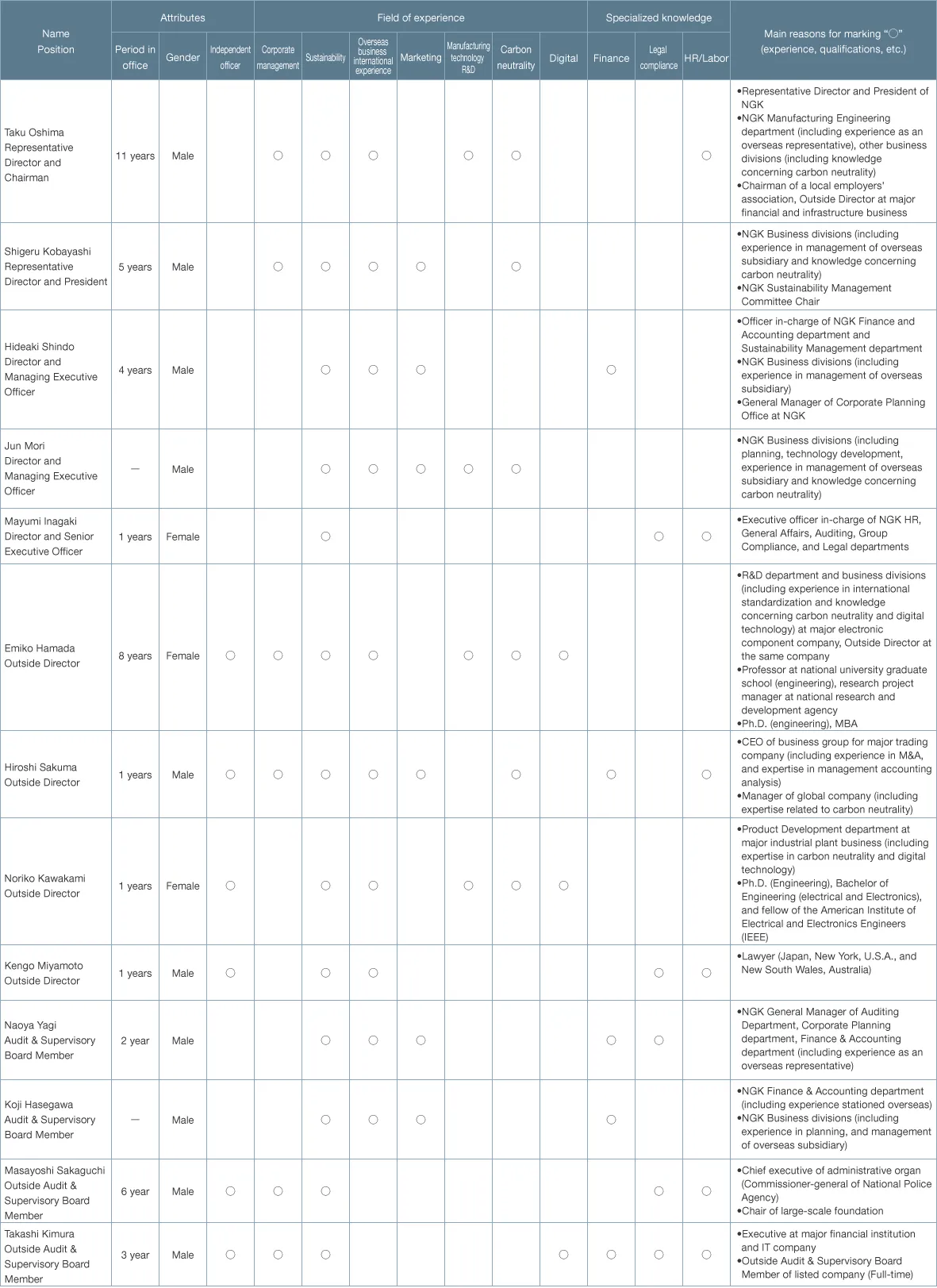
| Corporate management | We believe that experience in and knowledge about corporate management in particular are essential to ensure legality in business activities and transparency in management, as well as promote healthy risk-taking and effectively supervise appropriate decisionmaking and business execution. |
|---|---|
| Sustainability | Our management is centered on ESG (Environmental, Social, Governance) to realize the NGK Group Vision. We believe that experience and knowledge in the sustainability field in particular are essential to correctly recognize the ESG factors and other sustainability issues of the NGK Group and to connect these to the enhancement of our medium- to long-term corporate value by appropriately supervising and addressing initiatives aimed at sustainability issues. |
| Overseas business/ International experience |
We believe that experience in overseas business or other international experience in particular are essential to provide appropriate advice and effectively supervise business execution in the business of the NGK Group supplying materials such as ceramics and related products to a wide range of areas including overseas. |
| Marketing | Reinforcing societal implementation of our technologies and thereby commercializing products are indispensable for the realization of the NGK Group Vision. We believe that experience and knowledge gained through work including marketing in the sales or planning field in particular are essential to provide appropriate advice to the above activities and effectively supervise business execution. |
| Manufacturing technology R&D |
Creating new businesses early and encouraging innovation in production processes are indispensable for the achievement of New Value 1000 (aiming to attain 100.0 billion yen of sales in newly launched businesses in 2030) laid out in the NGK Group Vision. We believe that experience and knowledge in the manufacturing technology or R&D field in particular are essential to provide appropriate advice to the above activities and effectively supervise business execution. |
| Carbon neutrality | We have formulated the NGK Group Environmental Vision, aiming to build a main business in the field related to carbon neutrality (CN) through the transformation of our business structure, which is set forth in the NGK Group Vision, and aiming to contribute to the realization of “CN,” a “recycling-oriented society,” and “harmony with nature,” which are required by society, through our business activities. We believe that experience and knowledge regarding carbon neutrality in particular are essential to provide appropriate advice to, manage, and effectively supervise business strategies for achieving these objectives. |
| Digital | We have formulated the NGK Group Digital Vision, aiming to build a main business in the field related to digital society (DS) through the transformation of our business structure, which is set forth in the NGK Group Vision, and aiming to become a company where the use of data and digital technology will be commonplace in 2030, by positioning digital transformation (DX) as the driving force for our business transformation and accelerating DX throughout the NGK Group. We believe that experience and knowledge regarding digital technology in particular are essential to provide appropriate advice to, manage, and effectively supervise business strategies for achieving these objectives. |
| Finance | The NGK Group will strive to enhance its corporate value by accelerating the transformation of its business portfolio through the proper allocation of management resources as well as promoting three initiatives: enhanced profitability of capital, secured growth, and the enhancement of non-financial value. We believe that specialized knowledge in finance in particular is essential to provide appropriate advice to, manage, and effectively supervise financial strategies for promoting and achieving these objectives. |
| Legal Compliance Risk management |
The NGK Group has established the NGK Group Corporate Business Principles and Code of Conduct to stipulate how everyone working for the NGK Group should execute their jobs so that they abide by society’s laws and the Company’s Articles of Incorporation and comply with corporate ethics. It is the Board of Directors’ responsibility to ensure appropriate management by monitoring the status of compliance with these laws and ethics. In addition, the NGK Group views uncertainties that could affect the realization of its Group Vision as risks and has established measures tailored to each type of risk in order to prevent such risks in advance and minimize losses. The Board of Directors oversees the identification, assessment, and management of key risks through the Risk Management Committee and regularly verifies that the Company’s risk management framework is functioning effectively, with reference to international standards. Therefore, we believe that specialized knowledge in legal compliance and risk management in particular is essential. |
| HR/Labor | The NGK Group aims to add new value to society by developing an enriched and lively workplace environment where personnel with diverse experiences and values can play active roles, and each personnel autonomously embraces challenges and elevate each other. In addition, we have established the NGK Group Human Rights Policy to ensure that the human rights of all people affected by the NGK Group’s business activities will not be violated, promoting initiatives for respect for human rights. We believe that specialized knowledge regarding human resources and labor in particular is essential to provide appropriate advice to, manage, and effectively supervise human resources strategies for promoting and achieving these objectives. |
Policy on Board Composition with Diversity and Expertise
The Articles of Incorporation set the maximum number of Directors at 15. In appointing Directors, NGK places importance on diversity regardless of gender, age, nationality, or race. We promote diversity in terms of gender and international perspectives by appointing female Directors and Directors with experience in managing overseas subsidiaries. In addition, more than one-third of the Board of Directors consists of independent Outside Directors, thereby ensuring the independence of governance.
When nominating Directors, NGK places emphasis on experience areas defined in the skills matrix—corporate management, sustainability, overseas business and international experience, sales and planning, manufacturing technology and research and development, carbon neutrality, and digital—as well as on professional expertise in finance, legal affairs, compliance and risk management, and human resources and labor management.
The Chair of the Board of Directors is a non-executive Director. Full-time Audit & Supervisory Board Members and Outside Audit & Supervisory Board Members attend meetings of the Board of Directors and, when deemed necessary, state their opinions.
Activities of Board of Directors (Number of members: 10; Convened 15 times in FY2025)
In FY2025, the Board of Directors met 15 times. In accordance with the Companies Act, the Articles of Incorporation, and the Board of Directors Regulations, the Board resolved matters stipulated therein, including the consolidated company-wide budget; strategic plans such as the dissolution, merger, and alliance of the Company; the appointment and dismissal of the Representative Director; approval of business reports and financial statements; the acquisition and disposition of significant assets; and the appointment and dismissal of key personnel.
The Board also supervises the execution of duties by Directors.
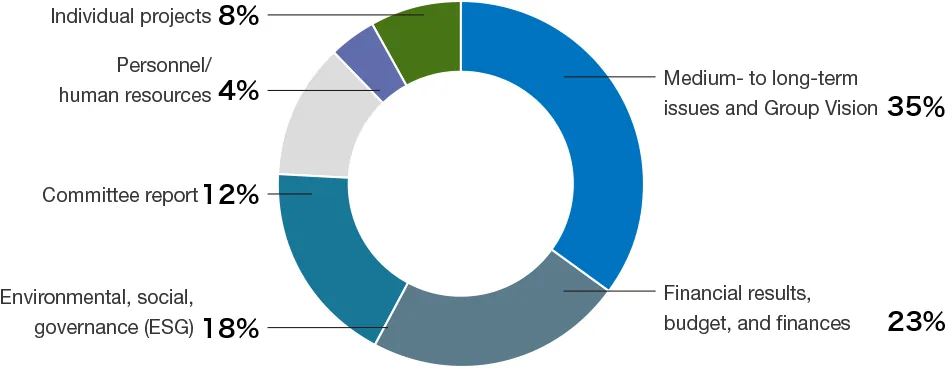
In FY2025, the Board of Directors discussed important agenda items in the following categories.
[Medium- to Long-Term Issues and Group Vision]
- Long-term Management Plan
- Initiatives for new business creation (Progress report on New Value 1000)
- Initiatives concerning business portfolio
- Determining key risks to follow-up on
[Financial Results, Budget, and Finances]
- Budget and financial results
- Sale of long-term shareholdings
- IR/SR activities report
[Sustainability]
- Progress report on fifth 5-Year Environmental Action Plan
- Information disclosure based on TNFD
- Reports on IR and SR Activities
- Revision of the NGK Group Social Contribution Activity Policy
[Committee Report]
- Report on principal committee activities
[Personnel/Human Resources]
- Organization and Personnel
- Committee for Deliberation on Respect for Human Rights
- Introduction of a Stock Incentive Plan for Key Personnel
[Individual Projects]
- Investment in production facilities, R&D, etc.
Audit & Supervisory Board / Audits
Composition of the Audit & Supervisory Board (As of June 30, 2026)
| Name | Age | Stocks held etc. | Meeting attendance record | ||||
|---|---|---|---|---|---|---|---|
| Number of shares of the Company held |
Number of stock acquisition rights owned (Equivalent number of shares) |
Board of Directors | Audit & Supervisory Board meeting | Nomination and Compensation Advisory Committee |
Business Ethics Committee | ||
| Naoya Yagi | 61 | 4,306 | - | 100% (15/15) |
◎ 100% (14/14) |
- | - |
| Koji Hasegawa | 62 | 1,040 | - | 100% (11/11)* |
100% (10/10)* |
- | - |
| Masayoshi Sakaguchi | 68 | - | - | 100% (15/15) |
100% (14/14) |
◇ 100% (5/5) |
100% (5/5) |
| Go Watanabe | 67 | - | - | - | - | - | - |
1. ◎ indicates the chair
2. ◇ indicates attendance as an observer
3. Meeting attendance shown is for FY2025
- *This information covers meetings of the Board of Directors and the Audit & Supervisory Board held on or after the date of appointment, June 26, 2025
Audit Policy and Audit Plan
The Audit & Supervisory Board formulates its audit policy and audit plan at the beginning of each fiscal year and identifies key audit focus areas. In FY2026, audits will be conducted in accordance with the following policy.
[Audit Policy]
Taking into account the business environment and other factors, the Audit & Supervisory Board and the Audit & Supervisory Board Members focus on monitoring management risks to ensure that the Company’s internal control systems function appropriately and that the soundness of the corporate group as a whole is maintained.
In addition to reviewing the crisis management framework for a wide range of risks, including natural disasters, they also confirm progress toward the NGK Group Vision and the extent to which it has been communicated and embedded both internally and externally.
Audits are conducted with a focus on risk management in day-to-day operations and the reasonableness of management decision-making. When necessary, individual matters are investigated, and efforts are made to enhance governance.
[Important Audit Items]
- 1NGK Group Vision
- 1The status of ESG-related initiative penetration
- 2The progress of new business, business restructuring, etc.
- 3Business-specific risk awareness and reasonableness of the management decision-making process
- 2Confirm framework for handling risk management and readiness to face future changes
Status of Audits by Audit & Supervisory Board Members (Number of members: 4; Convened 14 times in FY2025)
The Audit & Supervisory Board consists of four Audit & Supervisory Board Members and met 14 times in FY2025. Each Audit & Supervisory Board Member attends meetings of the Board of Directors and other important meetings, receives reports from Directors and employees, and, when necessary, requests explanations. Through these activities, they audit the decision-making processes of Directors and the execution of their duties.
In addition, they review the establishment and operation of the internal control systems and examine the appropriateness of the audit methods and results of the Independent Auditor.
In FY2025, the Audit & Supervisory Board mainly resolved and received reports on the following matters.
[Resolutions]
- Audit & Supervisory Board members' audit policy and audit plans, and audit reports of the Audit & Supervisory Board
- Consent to compensation for Audit & Supervisory Board members
- Confirmation of proposals and documents to be submitted to the General Meeting of Shareholders
- Consent to the comprehensive advance agreement for non-assured engagement that was provided by the auditing firm to which the accounting auditors belong, as well as its network firm
[Reports]
- Report on audit activities by full-time Audit & Supervisory Board members
- Audit plan by the Accounting Auditor
- Financial audit report by the Accounting Auditor
- Report on Financial Results by the Finance & Accounting Department
- Report on the results of internal audits by the Auditing Department
- Confirmation of the Convocation notice of the annual shareholder’s meeting
Internal Audits
NGK has established the Operational Audit Department (20 members as of the end of March 2025). Based on audit plans approved by the Board of Directors, the department audits the operations of NGK and its domestic and overseas group companies and reports the results to the President, the Board of Directors, and the Audit & Supervisory Board.
Internal audits are conducted independently from audits by the Audit & Supervisory Board Members and the Independent Auditor. However, in order to enhance effectiveness and efficiency, audit policies, plans, and results are regularly shared with the Audit & Supervisory Board and the Independent Auditor, and individual reports are provided when necessary.
Audits in specialized fields such as quality, the environment, and occupational health and safety are conducted by the secretariats of the respective committees, and the results are reported to the Board of Directors through those committees.
Accounting Audits
Our accounting audits consist of financial statement audits and internal control audits conducted by an audit firm in accordance with the Financial Instruments and Exchange Act, as well as audits conducted in accordance with the Companies Act.
In selecting the audit firm, the Audit & Supervisory Board makes its determination based on criteria such as the establishment of systems required under the Company Accounting Regulations, the maintenance of independence, the proper conduct of audits, and the absence of grounds for dismissal. Based on the results of this assessment, NGK has appointed Deloitte Touche Tohmatsu LLC as its audit firm.
In addition, the Audit & Supervisory Board Members and the Audit & Supervisory Board assess not only the appropriateness of the selection criteria but also, through their routine audit activities, whether communication with management, the finance department, and the internal audit department, audits of the Group as a whole, and responses to fraud risks are being conducted appropriately. Based on this assessment, they have concluded that the audit firm is qualified to serve as NGK’s audit firm.
Nomination and Compensation Advisory Committee
Nomination and Compensation Advisory Committee (Number of members: 6; Convened 5 times in FY2025)
The Nomination and Compensation Advisory Committee has been established as an advisory body to the Board of Directors to ensure fairness and transparency in decisions related to the appointment and compensation of officers.
Based on matters referred by the Board of Directors, the Committee deliberates on the appointment of Directors and Audit & Supervisory Board Members, compensation for Executive Officers, the upper limit of total compensation, and the succession plan for the Chief Executive Officer, and reports its recommendations to the Board of Directors.
The Committee consists of six members (four men and two women), with a majority being independent Outside Directors, and the Chair is also selected from among the independent Outside Directors. To ensure the appropriateness of deliberations, an Outside Audit & Supervisory Board Member attends meetings as an observer.
In FY2025, the Committee met five times and reported its key deliberations to the Board of Directors.
- Appointment of directors, representative directors, directors in key positions, and Audit & Supervisory Board members
- Compensation (cash and stock-related compensation) commensurate with the position of each individual director and executive officer
- Amount of performance-linked bonuses paid to each individual director this fiscal year
- Progress on development of successors to the Chief Executive Officer
Other Various Types of Meeting Bodies
Business Ethics Committee (Number of members: 7; Convened 5 times in FY2025)
The Management Ethics Committee consists of Outside Directors and an internal Director in charge of compliance, and met five times in FY2025.
The Committee investigates fraud and violations of laws and regulations involving Directors and other officers, and recommends measures to prevent recurrence to the Board of Directors.
In addition, the Committee reviews and proposes measures to the Board of Directors regarding the development of frameworks and activities to ensure compliance with laws and regulations related to competition law and the prevention of corrupt practices.
Furthermore, separate from the helpline system, the Company has established an internal reporting system (hotline) that directly reports to the Committee, thereby strengthening its compliance framework.
Corporate Council (Number of members: 12; Convened 2 times in FY2025)
The Management Council serves as a forum where Outside Officers and internal Directors exchange views on management issues and where Outside Officers provide advice to management.
In FY2025, the Council met twice and consisted of 12 members (nine men and three women).
Conference of Outside Directors and Outside Audit & Supervisory Board Members (Number of members: 6; Convened 2 times in FY2025)
The Conference of Outside Directors and Outside Audit & Supervisory Board Members consists solely of Outside Officers and serves as a forum for exchanging views on the Company’s management issues, with the aim of contributing proactively to discussions at the Board of Directors.
In FY2025, the Conference met twice and comprised six members (four men and two women).
Hearing Convened by Audit & Supervisory Board Members and Outside Directors (Number of members: 8; Convened 13 times in FY2025)
This initiative is carried out by Audit & Supervisory Board Members and Outside Directors (eight members in total: six men and two women) with the aim of collecting information from internal stakeholders on the Company’s business environment and challenges.
In FY2025, it was held 13 times.
Business Execution System
Executive Committee (Number of members: 16; Convened 23 times in FY2025)
The Executive Committee is the body that deliberates necessary matters to assist the president in making decisions. It consists of the president, executive vice presidents, group executives of each business group, the group executive of Corporate NV Creation, the group executive of Corporate R&D, the group executive of Corporate Manufacturing Engineering, directors in charge of each department, and full-time Audit & Supervisory Board members, as well as corporate officers, committee chairs, general managers and division heads designated by the president. Fifteen committee members are male and one is female.
| Strategy Committee | This committee conducts a broad range of discussions aimed at discovering problems and considering solutions concerning issues important to business management, strategy and policy planning, and reporting on the execution status and progress of various businesses and projects. |
|---|---|
| Sustainability Management Committee | This body assists the president, who is the Sustainability Management Committee chairperson, in decision-making about strategy, action plans, and important issues related to NGK Group sustainability (medium-to-long-term), as well as Environmental, Social, and Governance, and Sustainable Development Goals. It also performs deliberation for the presentation of agenda items deemed important to the Board of Directors or the Executive Committee. |
| Risk Management Committee | This is a body established to report important matters relating to risk management to the Board of Directors and Executive Committee, to assist the Board of Directors in supervising the Group’s risk management, and to contribute to increasing the sophistication of risk management. |
| Development and Commercialization Committee | This body deliberates items necessary to assist the decision-making of the president and Development and Commercialization Committee chair regarding policies, evaluations, budgets, major individual planning, and commercialization projects related to development and commercialization. |
| Capital Investments Committee | This body deliberates items necessary to assist the decision-making of the president and Capital Investments Committee chair regarding the examination and evaluation of policies, budgets, performance, and major individual planning related to capital expenditure and information systems. |
| Quality Committee | Aiming to increase customer satisfaction and trust by realizing even higher-quality products and services, this body deliberates the matters necessary to help the president and the Quality Committee chair with decision-making regarding the following items.
|
| Safety and Health Committee | This body performs overall management of the environment, safety and health for the NGK Group by regularly ascertaining overall conditions, and carrying out the necessary deliberations for making decisions on important policies, formulating action plans, and handling important matters. |
| Compliance Committee | This body assists the president and Compliance Committee chair with decision-making by deliberating essential matters pertaining to the following.
|
| Internal Controls Committee | This body deliberates matters necessary to help the president and Internal Controls Committee chair with decision-making regarding internal controls system assessment and reporting related to financial reporting based on the Financial Instruments and Exchange Act.
|
| HR Committee | This body assists the president with decision-making by examining issue presentation, research reporting, solution development, and other essential matters related to corporate obligations in respecting human rights (issue handling) and the important personnel policies within the NGK Group.
|
| BCP Countermeasures Headquarters | Aimed at ensuring business continuity in critical situations such as disasters, terrorism, or systems failure, this body executes the operation and maintenance of business continuity plans (BCP) in normal times as well as gives instructions on and support to restoration systems, and prioritizes restoration orders when BCP is in effect. |
| Central Disaster Prevention and Control Headquarters | This body executes requisite duties under commands from the Head and deliberates items necessary to assist the decision-making of the president and Head of this body regarding items related to earthquakes, storm and flood damage, fires, and explosions that threaten or significantly impact the company. |
| Security Export Control / Specified Export and Customs Clearance Control Committee |
This body deliberates and determines items necessary for guidance for subsidiaries and affiliates, legal compliance and the improvement of other internal systems with respect to security export controls, specified export declaration systems, and the management of customs clearance operations. |
Effectiveness of Board of Directors
Evaluation on the effectiveness of the Board of Directors
Analysis and Evaluation Results concerning the Effectiveness of Board of Directors
NGK’s Board of Directors conducts a survey of directors and Audit & Supervisory Board members at the close of each fiscal year on the effectiveness of Board of Directors meetings. The Board entrusts analysis and evaluation of the responses to an external organization, which reports the results to the Board of Directors. NGK continually strives to improve effectiveness through such means as considering the importance and necessity of each issue identified and reinforcing efforts in Board of Directors meetings during the next fiscal year.
1. Policy on Initiatives and Main Initiatives for FY2024, Based on the Effectiveness Evaluation Covering FY2023
- 1Board of Directors policy on initiatives
- The following items should continue to be monitored and regularly reported to the Board of Directors in order to achieve the NGK Group Vision
- Status of the business portfolio revision
- Progress of the New Value 1000 (aiming for sales of 100 billion yen from new commercialized products by 2030)
- Progress of various committee activities and company-wide projects
- Progress of human resources strategy
- Status of company-wide risk management
- IR and SR activities
[Primary Initiatives]
We also established multiple reporting periods for each of the annual agenda items above, and reported to the Board of Directors. Concerning our human resources strategy, above all, we discussed the ideal form of personnel system for key personnel (managers) and resolved to revise our Key Personnel System in order to promote maximum utilization of and autonomous action by diverse personnel.
- Identify issues that should be given priority for discussion, and deepen discussion of long-term management plans and business strategies (including group companies)
[Primary Initiatives]
Continuing from FY2023, the energy storage business, and Group subsidiary strategy were discussed intensively at the expansion strategy meeting, which was held twice and also attended by outside officers. - Work to enhance opportunities for dialogue between senior management and outside officers, while deepening discussions on succession plans and training senior management
[Primary Initiatives]
Lunch meetings between senior management and outside officers were held once a month with participants sitting wherever they liked. We also promoted more vigorous and substantial exchange of opinions by setting up interviews between outside directors and executive officers. Meanwhile, senior management attended hearings convened by Audit & Supervisory Board members and outside directors, and reported on the general state of the business. - Strive to further enhance provision of information to outside officers
[Primary Initiatives]
Concerning items on the agenda for the Board of Directors, we strove to further enhance opportunities for individual explanations according to department in charge, etc. At the same time, we put in place a framework that provides outside officers with constant access to materials related to the execution of business and used by the Executive Committee, Strategy Committee, and various other committees.
- The following items should continue to be monitored and regularly reported to the Board of Directors in order to achieve the NGK Group Vision
- 2Policy on initiatives for the Nomination and Compensation Advisory Committee
- Continue striving to further share the state of committee discussions with the Board of Directors
[Primary Initiatives]
The state and content of committee discussions were carefully shared with the Board of Directors using committee materials. In addition, intentions regarding the deployment of senior management were reported to the Board of Directors by the President when decisions were made concerning the organization or personnel. - Continue striving to further enhance provision of information to the Nomination and Compensation Advisory Committee
[Primary Initiatives]
More detailed data about the personal history, skills, and expected roles of new directorial candidates and Audit & Supervisory Board members was provided to each committee member by the committee secretariat.
- Continue striving to further share the state of committee discussions with the Board of Directors
2-1. Methods of Effectiveness Evaluation for FY2024
- 1A survey comprising a total of 30 questions, 6 questions evaluating the initiatives for FY2024, and two free-response entries was conducted on all directors (10 members) and all Audit & Supervisory Board members (4 members) at the beginning of April 2025, and the analysis and evaluation of the responses were entrusted to an external organization.
The survey questions are also periodically reviewed in light of changes to the current environment. - 2In addition, as part of the effectiveness evaluation of the Board of Directors, the Nomination and Compensation Advisory Committee has conducted a questionnaire to its members (chairperson, members, and observers), and entrusted the analysis and evaluation of the responses to an external organization.
2-2. Summary of Evaluation Results for FY2024
- 1A summary of the evaluation results was reported to the Board of Directors at its meeting on June 6, 2025.
- 2Based on the results of the questionnaire, the external evaluation of the effectiveness of the Board of Directors (including the Nomination and Compensation Advisory Committee) was high overall, and stated that the Board of Directors is operating appropriately.
- 3Overall comments from external organizations are as follows.
- The NGK Board of Directors has an appropriate member composition and suitably comprises elements that form the foundation necessary as a Board of Directors, including the commitment of each member and a healthy culture. These have been maintained as strengths based on the results of the past few years.
- The Nomination and Compensation Advisory Committee conducts practical discussions and evaluates whether it has properly shared the details of these with the Board of Directors.
- The policies for initiatives in FY2024 were drawn up based on the results of the effectiveness evaluation for the previous fiscal year. In response, they set up opportunities for discussion about business strategy, expanded the information shared with outside directors, and strove to broaden the content of reports from the Nomination and Compensation Advisory Committee. These efforts have plainly helped to enhance the effectiveness of the Board of Directors.
- Although a certain amount of progress was observed on discussions about business strategy, it is important to continue to deepen such discussions. In order to achieve the Group Vision and further enhance its effectiveness, it is recognized that this must also lead to formulating specific policy measures, which include optimizing the business portfolio and discussing unprofitable businesses.
- The identification and narrowing-down of the issues to be placed on the agenda for the Board of Directors is an ongoing challenge for appropriately conducting such discussions.
- It has been pointed out that, to deepen discussions, appropriately reviewing past management decisions, and connecting this to future action, are crucial.
- The further enhancement of initiatives for succession planning and training, and the performance evaluation, treatment, etc. of senior management, are thought to be ongoing challenges for discussions of the Board of Directors.
3. Policy for Initiatives for FY2025 to Further Improve Effectiveness
Based on the results of the evaluation in FY2024 and discussions by the Board of Directors, we have formulated the following policies for initiatives for FY2025.
We will strive to improve the effectiveness of the Board of Directors and the Nomination and Compensation Advisory Committee through continuous efforts.
- 1Policies for initiatives of the Board of Directors
- To realize the NGK Group Vision, the following items shall continue to be regularly reported to, discussed, and monitored by the Board of Directors.
- Overall progress of the medium-term management plan
- Initiatives for transforming our business portfolio
- Progress of New Value 1000 (aiming for sales of 100 billion yen from new commercialized products by 2030)
- Status of company-wide risk management
- IR and SR activities and various committee activities
- Identify issues that should be given priority for discussion, and deepen discussion of business strategies (including for group companies), then connect this to monitoring unprofitable businesses and formulating specific policy measures
- Further enhance opportunities for dialogue between senior management and outside officers, while deepening discussions on succession planning, senior management development, treatment of senior management, etc.
- Policies for initiatives of the Nomination and Compensation Advisory Committee
- Work to further share the status of discussions from the committee to the Board of Directors, while further ensuring the appropriateness of the committee’s discussion process
- Work to further enhance the information provided to the committee related to compensation and nomination
- To realize the NGK Group Vision, the following items shall continue to be regularly reported to, discussed, and monitored by the Board of Directors.
Training Policies for Officers
In light of the fact that Directors and Audit & Supervisory Board Members owe a duty of due care as mandatees of the Company, the Company provides training based on the following policy to ensure that they can fully fulfill their responsibilities as management professionals or supervisors of business execution.
Training policy
- 1For internal Officers
Training on the Companies Act, the Financial Instruments and Exchange Act, competition law, and matters related to corporate governance and compliance.FY2025 training results
- Training on competition law and quality compliance (one session in total)
- 2For Outside Officers
Briefings by the relevant departments on agenda items submitted to the Board of Directors, regular provision of information on the business environment and challenges, and opportunities for the exchange of views.FY2025 training results
- Site visits by Outside Directors and Outside Audit & Supervisory Board Members (four visits in total: Co-Creation Center, Nagoya, Yamaguchi, and Yamanashi)
- Advance briefings and business briefings related to meetings of the Board of Directors, etc. (14 sessions in total)
- Hearings with executive departments conducted by Audit & Supervisory Board Members and Outside Directors (13 sessions in total)