
Nomination and Compensation for Directors and Audit & Supervisory Board Members
Matters Related to Nomination, Appointment and Dismissal
Policy on Nomination, Appointment, and Dismissal
The NGK Group’s core business is manufacturing. It supplies ceramics and other materials, as well as related products, to a wide range of business fields and regions, including overseas markets.
The Representative Director, Directors with specific titles, Directors and Executive Officers who are responsible for business execution are expected to make management decisions based on diverse perspectives. These include individual expertise in the Group’s various business fields, manufacturing technologies, and research and development, as well as knowledge of finance, legal affairs, and human resources and labor. Full-time Audit & Supervisory Board Members are also required to conduct audits based on their professional expertise, such as finance, and insights gained through experience in individual businesses.
Accordingly, when nominating candidates for Directors and full-time Audit & Supervisory Board Members, the Company places emphasis on the following experience areas and expertise defined in the skills matrix: corporate management, sustainability, overseas business and international experience, sales and planning, manufacturing technology and research and development, carbon neutrality, digital, finance, legal affairs, compliance and risk management, and human resources and labor.
Candidates for Outside Directors and Outside Audit & Supervisory Board Members are nominated from among individuals who possess a high level of expertise in areas such as legal affairs and corporate finance, as well as broad insight into international affairs, socio-economic trends, technological trends, and corporate management.
The total number of Directors is limited to 15, as stipulated in the Articles of Incorporation.
In selecting the Representative Directors and Directors with specific titles, we place emphasis on their ability to identify issues facing the Group and formulate appropriate measures, as well as their leadership to present the desired future state of the Group and mobilize the organization.
On the other hand, a Director may be dismissed if the Nomination and Compensation Advisory Committee determines that dismissal is appropriate due to serious violations of laws, the Articles of Incorporation, or other Group regulations, or due to circumstances that significantly hinder the execution of duties, and such dismissal is approved by a resolution of the Board of Directors.
This policy is deliberated by the Nomination and Compensation Advisory Committee, which is composed of a majority of Independent Outside Directors, and its resolutions are submitted to the Board of Directors.
Procedures for Nomination, Appointment, and Dismissal
When nominating candidates for the positions of director and Audit & Supervisory Board member, all representative directors discuss each candidate and obtain consent from the Audit & Supervisory Board for Audit & Supervisory Board member candidates. In addition to this, NGK strives to ensure fairness, transparency, and timeliness in the process of nomination, appointment, and dismissal. This is accomplished through deliberation on the nomination of each candidate for director and Audit & Supervisory Board member, and appointment and dismissal of representative directors and directors with special titles by the Nomination and Compensation Advisory Committee, which has independent outside directors as a majority of its members. The committee then reports its detailed conclusions to the Board of Directors. After the Board of Directors has sufficiently considered the conclusions of the committee, the Board nominates candidates for the positions of director and Audit & Supervisory Board member, and approves this as an agenda item (resolution) for the General Meeting of Shareholders. After directors are elected by the General Meeting of Shareholders, the Board of Directors appoints representative directors and directors with special titles, based on the report by the Nomination and Compensation Advisory Committee.
Conclusion of Limited Liability Contract
To enable Outside Directors and Outside Audit & Supervisory Board Members to fully perform their roles, the Company has entered into liability limitation agreements with them in accordance with the Companies Act. Under these agreements, when they act in good faith and without gross negligence, their liability for damages is limited to the minimum liability amount prescribed by the Companies Act. This framework allows Outside Directors and Outside Audit & Supervisory Board Members to carry out their duties from a neutral and objective standpoint.
State of D&O Liability Insurance
Based on a resolution of the Board of Directors, the Company has entered into a D&O liability insurance agreement for its officers. The insured persons are all of the Company’s Directors, Audit & Supervisory Board Members, and Executive Officers.
This insurance covers compensation for damages and dispute expenses incurred when officers are subject to claims for damages arising in connection with the execution of their duties. However, losses resulting from the provision of illegal benefits, criminal acts, or acts committed with knowledge of their illegality are excluded from coverage, thereby ensuring the appropriateness of the execution of duties. Insurance premiums are paid in full by the Company.
Criteria for Determining Independence of Outside Officers
Outside Directors
In addition to the requirements for an outside director under the Companies Act and for an independent director specified by the Tokyo Stock Exchange, NGK may not designate a person who falls under any of the following items as an outside director with independence (hereinafter referred to as the “Independent Outside Director”). Even if a person falls under one or more of these items, NGK may make an exception and deem a person suitable for serving as an Independent Outside Director of NGK in light of his or her character, knowledge, and other attributes. However, the person must still meet the requirements of the Companies Act and Tokyo Stock Exchange and the Company must provide an external explanation of why such person is suitable to serve as an Independent Outside Director of NGK.
In these standards for determining independence, a business executive refers to an executive director, executive officer, corporate officer or other employee, and the NGK Group refers to NGK and its subsidiaries or affiliates.
- 1A major shareholder who holds 10% or more of current voting rights in NGK, or who was a business executive of the corporation if the major shareholder is a corporation during the past three fiscal years, including the most recent fiscal year.
- 2A current business executive of a business partner of the Company which has engaged in transactions with the NGK Group totaling 2% or more of consolidated net sales for either party in any of the last three fiscal years, including the most recent fiscal year.
- 3A person who was a business executive in a corporation that is a financial institution or other major creditor which is absolutely essential in financing the NGK Group and for which no alternatives exist, during the past three fiscal years, including the most recent fiscal year.
- 4A current director or officer of an organization that has received donations or grants totaling 10 million yen/year or 30% of total average annual expenses of the organization, whichever is greater, from the NGK Group in any of the past three fiscal years, including the most recent fiscal year.
- 5A certified public accountant (CPA) or tax accountant, or a current employee of an accounting firm or tax accounting firm who served as an accounting auditor or accounting advisor of the NGK Group during the past three years, including the most recent fiscal year.
- 6An attorney, certified public accountant, tax accountant, or other consultant who does not correspond to any of the individuals mentioned above in 5, who received 10 million yen/year or more in cash and other assets in addition to officer compensation from NGK Group during the past three years, including the most recent fiscal year, or who does not correspond to any of the individuals mentioned above in 5 and is a current employee, etc. of a law firm, accounting firm, tax accounting firm, consulting firm, or other organization that provides expert advice, and that organization has received payments from the NGK Group totaling 2% or more of total consolidated net sales in any of the past three fiscal years, including the most recent fiscal year.
- 7A person who was a business executive in a company in which NGK is currently a major shareholder, during the past three fiscal years, including the most recent fiscal year.
- 8A spouse or relative within the second degree of kinship of anyone to whom the preceding items 1 through 7 apply.
Outside Audit & Supervisory Board Members
In order to ensure that outside Audit & Supervisory Board members are impartial and that there is no conflict of interest with our general shareholders, NGK makes comprehensive decisions based on the Securities Listing Regulations of the Tokyo Stock Exchange.
Reasons for Individual Appointments
| Name | Reasons for appointment |
|---|---|
| Emiko Hamada | Ms. Emiko Hamada has made remarkable achievements such as leading the invention and the world’s first commercialization of the CD-R (recordable CD) while working for Taiyo Yuden Co., Ltd. Since then, she has been engaged in research activities mainly through industry-academia-government collaborations as Professor at Nagoya Institute of Technology and Visiting Professor at Nagoya University. The Company expects her to oversee the management of the Company from an independent, objective standpoint based mainly on the perspective of research, development, and product commercialization, by utilizing the insights she has developed through her career. In addition, she has been appropriately fulfilling her duties as an Outside Director of the Company by giving her opinion in terms of ways to proceed with product development and new business and also on human resources measures, as well as offering suggestions to the Company’s business operation and overseeing the management of the Company, therefore we renominated her as a candidate for Outside Director. |
| Hiroshi Sakuma |
Mr. Hiroshi Sakuma has extensive knowledge of energy fields including carbon neutrality, as well as experience leading large organizations, through his work in important positions at Mitsubishi Corporation such as Division COO of New Energy & Power Generation Div. and subsequently Executive Vice President, Group CEO of Global Environmental & Infrastructure Business Group, as well as Member of the Management Board and Chief Cooperation & International Officer of N.V. Eneco*. The Company expects him to oversee the management of the Company as an Outside Director and a management specialist from an independent, objective standpoint, by utilizing those insights and experience. In addition, he has been appropriately fulfilling his duties as an Outside Director of the Company by giving his opinions on management decisions and overall business activities from an investor’s perspective, as well as offering suggestions to the Company’s business operation and overseeing the management of the Company, therefore we renominated him as a candidate for Outside Director.
|
| Noriko Kawakami |
Ms. Noriko Kawakami has long engaged in product development in the power electronics field at Tokyo Shibaura Electric Co., Ltd. (currently Toshiba Corporation) and Toshiba Mitsubishi-Electric Industrial Systems Corporation (currently TMEIC Corporation) and possesses extensive knowledge and ample work experience in product development and manufacturing, such as leading the development and commercialization of large-capacity power converters applied to power grids and infrastructure facilities that use renewable energy and so forth. She was awarded the title of fellow from the IEEE* for her contributions to the development and commercialization of this technology. The Company expects her to offer suggestions to the Company’s business operation from a practical perspective and oversee the management of the Company from an independent, objective standpoint as an Outside Director, by utilizing those insights and experience. In addition, she has been appropriately fulfilling her duties as an Outside Director of the Company by giving her opinion in terms of ways to proceed with supply chain development and cost reduction methods and also on intellectual property strategies, as well as offering suggestions to the Company’s business operation and overseeing the management of the Company, therefore we renominated her as a candidate for Outside Director.
|
| Kengo Miyamoto | Having long engaged in legal practice domestically and internationally as an attorney-at-law, Mr. Kengo Miyamoto possesses a wealth of work experience and specialized knowledge, including providing a wide range of advice to a number of Japanese and international companies in various fields such as manufacturing, service, transportation, and IT. The Company expects him to oversee the management of the Company as an Outside Director from an independent, objective standpoint based mainly on the perspective of compliance, by utilizing those insights and experience. In addition, he has been appropriately fulfilling his duties as an Outside Director of the Company by giving his opinion on matters such as legal strategies and improving the effectiveness of the internal reporting system, as well as offering suggestions to the Company’s business operation and overseeing the management of the Company, therefore we renominated him as a candidate for Outside Director. |
| Name | Reasons for appointment |
|---|---|
| Masayoshi Sakaguchi | Mr. Sakaguchi has a wealth of experience in the administrative sector and a proven track record in managing large organizations. He was chief of the Osaka Prefectural Police Headquarters, chief of the Commissioner-General’s Secretariat (National Police Agency), and commissioner-general of the National Police Agency. We have determined he can contribute to improving NGK’s corporate value such as by making use of this experience to express his opinions on the impact of the international situation on business activities, and strengthening our risk management structure as an NGK Outside Audit & Supervisory Board member from the viewpoint of the legality of business and risk management. We have therefore elected him to the position of outside Audit & Supervisory Board member. Mr. Sakaguchi has no personal, financial, or important business relationship with, nor other vested interest in, NGK. He has served as executive advisor to Nippon Life Insurance Company, which is both an NGK shareholder and a source of financing for NGK. However, at the end of FY2025, the Nippon Life Insurance Company's holdings did not exceed more than 1.03% of total NGK shares. Moreover, with regard to the financing received, NGK has business transactions with numerous financial institutions, and the nature of the financing secured from Nippon Life Insurance Company is not such that NGK is in any way beholden to it. Therefore, we deem the shareholding and financial borrowing relationship between NGK and Nippon Life Insurance Company to be one which would not impact NGK’s management decision-making. Moreover, the total amount of NGK payments to Nippon Life of management fees for corporate pension plans is less than 0.1% of consolidated operating expenses and, thus, does not create a conflict of interest with our general shareholders. Concurrent with his work with NGK, Mr. Sakaguchi serves in a variety of roles, including as president of the Japan Automobile Federation. However, no personal, financial, or important business relationship, nor other vested interest, exits between NGK and the organizations with which he currently works. |
| Go Watanabe | Mr. Go Watanabe has held various positions, including managing executive officer at the Bank of Tokyo-Mitsubishi UFJ, Ltd. (currently MUFG Bank, Ltd.) and has held executive positions at financial companies and manufacturing companies, having been involved in corporate management for many years. In addition to the experience and expertise in finance and corporate governance he has cultivated throughout his career, including many years of overseas assignments, he currently serves as a full-time Audit & Supervisory Board Member at Mitsubishi Gas Chemical Company, Inc., and possesses extensive experience and expertise as an auditor of a publicly listed company. We have nominated him as a candidate for Outside Audit & Supervisory Board Member, believing that he can contribute to enhancing the Company’s corporate value by auditing its overall management from these experiences. There are no personal relationships, capital relationships, significant business transactions, or other conflicts of interest between the Company and him. Although he is a former employee of MUFG Bank, Ltd., which is a shareholder of the Company as well as a financial institution providing financing to the Company, the Bank’s shareholding ratio in the Company as of the end of FY2025 is limited to 2.46%. In addition, the Company conducts transactions with many financial institutions and does not depend on the Bank to an extent that would make it irreplaceable as a source of financing. Furthermore, it has already been ten years since he left MUFG Bank, Ltd. Accordingly, we have determined that his judgment is not influenced by the intentions of MUFG Bank, Ltd., and that there is no risk of a conflict of interest with general shareholders. Other than the above, there are no personal relationships, significant capital relationships, major business transactions, or other conflicts of interest between the Company and any other significant positions concurrently held by him. |
NGK has submitted written notification to the Tokyo Stock Exchange and Nagoya Stock Exchange of the appointment as independent officers of the above six individuals.
CEO Succession Planning
The NGK Group has formulated a succession plan for the Chief Executive Officer that defines the required qualities of a CEO successor, development policies, and decision-making procedures. Based on this plan, the Representative Director and President reports annually on its progress to the Nomination and Compensation Advisory Committee, which reviews the appropriateness of the plan.
Matters Related to Compensation
Policy for Determining Compensation
Basic Concept
The compensation system for NGK directors and others has been established for the purpose of contributing to the Group’s sustainable growth and the enhancement of its medium-to-long-term corporate value by practicing the NGK Group Philosophy and realizing the NGK Group Vision. We reassess whether the level and composition of compensation is appropriate in light of those objectives and revise it as appropriate. The Company also strives to ensure transparency and fairness in governance of compensation.
General Meeting of Shareholders Resolutions on Compensation
| Persons eligible for payment | Date and details of the resolution | Number of persons eligible for payment at the time of resolution | Reference: Type of compensation |
|---|---|---|---|
| Directors | June 29, 2026 Amount of compensation etc.: One billion yen or less in an annual amount |
10 (including 4 outside directors) | Basic compensation and performance-linked bonuses (excluding outside directors) |
| Directors (excluding outside directors) |
June 29, 2026 Total amount of monetary claims to be paid as compensation for the grant of restricted shares: 400 million yen or less in annual amount |
6 | Restricted share compensation |
| Audit & Supervisory Board Members | June 26, 2023 Amount of compensation etc.: 150 million yen or less in annual amount |
4 | Basic compensation |

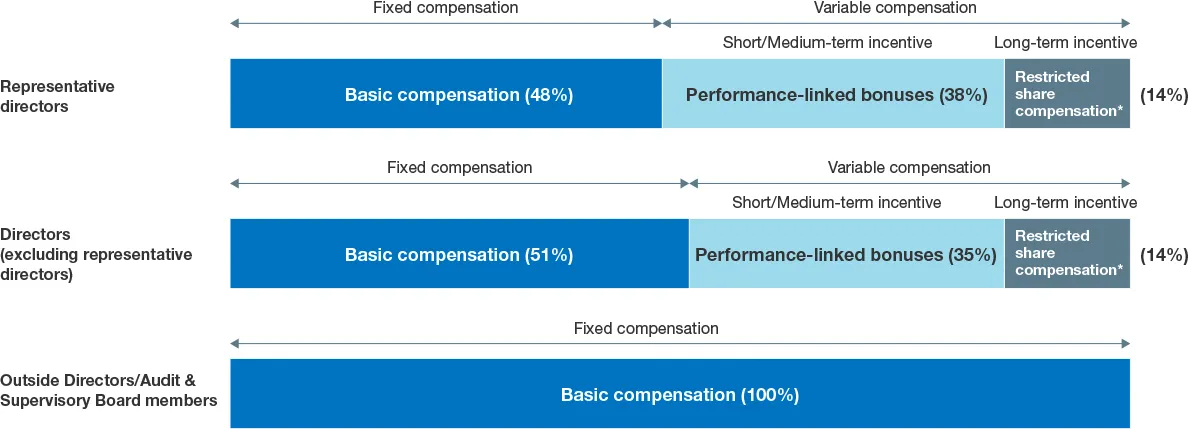
- *Restricted share compensation is a mechanism which assumes that shares will be held long-term until the director steps down, and which is indirectly linked to company performance through stock price
Items Related to Performance-linked Compensation, etc.
Details of Performance Indicators and Reasons for their Selection Based on Calculation of Performance-linked Compensation Amount
NGK pays performance-linked bonuses as performance-based compensation to Directors (excluding Outside Directors) and Executive Officers. The indicators used to calculate these bonuses are as follows.
For short-term indicators, we place importance on the achievement of performance targets and year-on-year growth, while also taking capital efficiency into account. Accordingly, the following consolidated performance figures are adopted.
- Percent change in net sales, operating income, and net income for the current fiscal year compared to the previous fiscal year
- Targets and percent change for return on invested capital (ROIC)* set at the beginning of (or during) the period
- *Using NGK ROIC (calculated based on operating income, accounts receivable, inventories, and fixed assets)
With a focus on medium-term growth, and from the perspective of achieving the NGK Group Vision and emphasizing ESG (Environmental, Social, and Governance), we revised our executive compensation system in fiscal 2026. The degree to which we attain our targets for the following material issues in each fiscal year serves as an indicator of our progress toward achieving the NGK Group Vision.
- Growth rate of operating income under the medium- to long-term performance targets in the Long-Term Management Plan
- Level of achievement in creating new products and new businesses
- Level of achievement in enhancing NGK’s proprietary added value
- Level of achievement in improving employee engagement
In addition, in fiscal year 2025, we use the degree of achievement against annual targets for the following material issues as performance indicators.
- Change in operating profit, among the NGK Group Vision medium- to long-term performance targets
- Degree of achievement in creating new products and new businesses
- Degree of achievement of the annual target for CO2 emissions reductions
Method for Calculating Performance-linked Compensation
We follow the method below to determine the amount of performance-linked bonus paid to each individual.
- (a)Set a base bonus amount calculated for each position.
- (b)Apportion the base bonus amount among each performance indicator. Allocate a higher percentage to items that take a medium-to- long-term perspective than to those that take a short-term perspective. Then include the representative director's evaluation of the individual performance of each other director and executive officer in the allocation items.
- (c)Evaluate each allocation item over a scale of -100% to +100%, and calculate the appraised value for each item.
- (d)Sum up these amounts to calculate the amount of performance-linked bonus.
As a result, the actual performance-linked bonus paid will vary from -100% to +100% of the base bonus amount.
| Item | Percent Allocated | Evaluation Coefficient Variance Ratio | Performance Appraisal Indicators (Calculated in practice by replacing each indicator with the variance ratio and evaluating it.) |
|---|---|---|---|
| Short-term Indicators | 40% | -100% to +100% |
Consolidated results (net sales / operating income / net income)
|
| -100% to +100% |
Return on invested capital
|
||
| Medium- to long-term Indicators | 60% | -100% to +100% |
Medium- to long-term performance targets (operating income)
|
| -100% to +100% |
Degree of achievement of key issues (main items are as follows):
|
Non-monetary Compensation etc.
Details of Non-monetary Compensation
NGK grants restricted share compensation to directors (excluding outside directors) and executive officers (excluding executive officers who are overseas residents on a non-temporary basis) in order to increase their sensitivity to stock price, to further share with shareholders the benefits and risks associated with stock price fluctuations, and to motivate them to improve corporate value over the medium to long-term. Since stock price fluctuations are directly related to its value, the amount of restricted shares is not fixed, but the number of shares granted is fixed in accordance with the position.
The following is an overview of the restricted share compensation we granted in FY2025.
| Issuance Overview | |
|---|---|
| Class and number of shares to be issued | NGK common stock: 118,750 shares |
| Issue price | 1,816.5 yen per share |
| Aggregate issue amount | 215,709,375 yen |
| Persons eligible for the allotment of the shares and the number thereof, as well as the number of shares to be allotted | NGK directors (excluding outside directors): 6 people, 39,750 shares executive officers who do not concurrently serve as NGK directors: 24 people, 79,000 shares (excluding executive officers who are overseas residents on a non-temporary basis) |
- *Period of the transfer restriction stipulated in the restricted share allotment agreement (hereinafter “the Allotment Agreement”):
The allottees must not transfer, establish as security interests or otherwise dispose of NGK’s ordinary shares allotted to them according to the Allotment Agreement from the date on which they receive their allotment according to the Allotment Agreement to the point in time directly after retiring from the position determined in advance by NGK’s Board of Directors from among the positions of NGK’s officers and employees - *In fiscal 2025, NGK granted 45,000 shares of treasury stock as restricted stock compensation to directors (excluding outside directors). Following the passing of a director, NGK acquired 5,250 of these shares without consideration
Claw Back Clause
NGK has a provision to acquire all of the accumulated allotted stocks without compensation in the event that the allottee of the restricted shares violates laws and regulations during the period of the transfer restriction, or in the event that certain other conditions stipulated in the allotment agreement are met.
Stock Holding Guideline for Directors and Executive Officers
In order to foster a sense of shared value between directors and executive officers and shareholders, and to contribute to the sustainable growth of the NGK Group and the enhancement of its corporate value over the medium to long-term, NGK has established guidelines for holding its own stock, etc.*1 and in principle, within three years of assuming office, directors and executive officers shall endeavor to hold company stock, etc. equivalent to the following values.
| Persons eligible | |
|---|---|
| Directors (Chairman and President) | 200% or more of basic compensation (annual amount) |
| Directors*2 and Executive Officers*3 | 150% or more of basic compensation (annual amount) |
- *1Includes stock compensation-type stock options that have not yet reached the exercise commencement date
- *2Excluding Chairman, President, and outside directors
- *3Excluding executive officers who are overseas residents on a non-temporary basis
Amount of Compensation for Directors and Audit & Supervisory Board Members
| Director category | Total compensation (million yen) |
Total compensation by type (million yen) |
Applicable officers (people) |
||
|---|---|---|---|---|---|
| Fixed Compensation | Performance-linked compensation | Restricted share compensation | |||
| Directors (excluding Outside Directors) |
566 | 279 | 208 | 78 | 8 |
| Outside Directors | 56 | 56 | ‒ | ‒ | 4 |
| Audit & Supervisory Board Members (excluding Outside Audit & Supervisory Board Members) |
70 | 70 | ‒ | ‒ | 3 |
| Outside Audit & Supervisory Board Member | 28 | 28 | ‒ | ‒ | 2 |
- 1.The total amount of remuneration and other compensation, the breakdown by type of remuneration, and the number of Directors covered above (excluding Outside Directors) include two Directors who retired on June 26, 2025, and one Director who retired on September 2, 2025, as well as the amounts of remuneration and other compensation paid to each of them
- 2.The total amount of remuneration and other compensation, the breakdown by type of remuneration, and the number of Audit & Supervisory Board Members covered above include one Audit & Supervisory Board Member who retired on June 26, 2025, as well as the amount of remuneration and other compensation paid to that individual
| Name | Officers category | Company category | Total compensation by type (million yen) | Total compensation (million yen) | ||
|---|---|---|---|---|---|---|
| Fixed compensation | Performance-linked compensation | Restricted share compensation | ||||
| Taku Oshima | Director | Submitting company | 67 | 66 | 18 | 153 |
| Shigeru Kobayashi | Director | Submitting company | 67 | 66 | 18 | 153 |
Average Employee Compensation and President Compensation
In FY2025, the remuneration of the Representative Director and President of NGK amounted to 153,000,000 yen, while the average remuneration of employees was 9,200,112 yen, resulting in a remuneration ratio of 16.6 times.