
Pusher Kiln
- Business fields
Overview
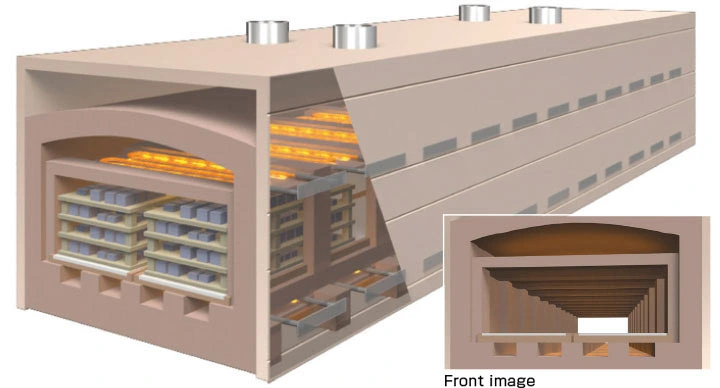
This continuous kiln loads the workpieces to be fired onto base plates and transports them by pushing the base plate with a pusher mechanism at the kiln entrance. NGK pusher kilns are continuous kilns that perform firing in a stable kiln temperature and atmosphere, and are widely used primarily in the electronics field and similar fields.
Automatic Pusher Kiln
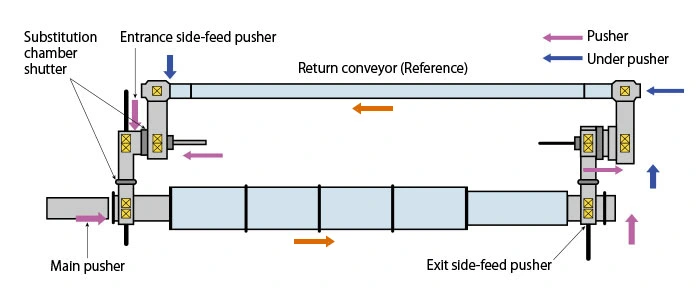
Layout example
Examples of stable kiln internal atmospheres
| Hard ferrite | Air |
|---|---|
| Soft ferrite | N2、Air |
| Ceramic capacitor | Air、H2 |
| Semiconductor capacitor | H2 + N2 |
| Varistor | H2 + N2 |
| Thermistor | N2、Air |
| Piezoelectric ceramics | Air、N2 |
| Alumina substrate | Air |
| Tungsten metallization | H2 + N2 |
Features
-
Uniform temperature and atmosphere
These kilns can maintain a stable internal atmosphere. Because gas can also be supplied from the bottom of the kiln between the rows, this reduces the temperature and atmosphere variation in the up/down and left/right directions.
-
Capable of mass production
Because the kiln uses multi-level transport, it is capable of mass production with improved surface area productivity. By using it together with tools that have good thermal conductivity, it is possible to shorten the profile.
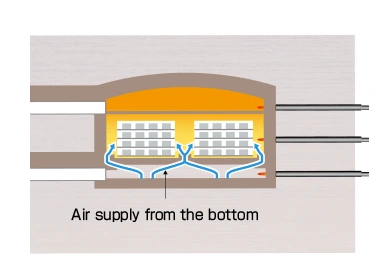
Because gas can also be supplied from the bottom of the kiln between the rows, it is possible to produce a uniform gas flow.
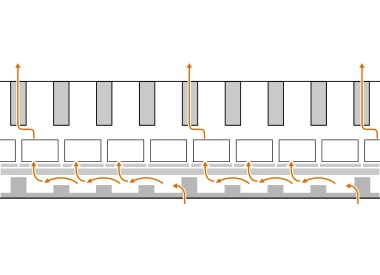
This is an NGK original flow control structure that maintains a special atmosphere inside the kiln. This atmosphere gas control technology produces good gas flow between the individual independent small chambers. As a result, the flow of gas throughout the kiln is also good and it is possible to maintain a stable and uniform atmosphere.
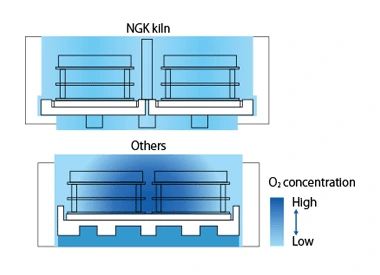
Producing a uniform gas flow results in little variation in the oxygen concentration or temperature distribution, allowing a uniform atmosphere to be maintained inside the kiln.
Examples of use
Lithium-ion battery materials(cathode and anode), Ceramic capacitor (MLCC), Piezoelectric element, Thermistor, Varistor, Inductor, Ferrite, Phosphor, etc.
Specifications
| Temperature | Maximum heating temperature 1,650˚C |
|---|---|
| Atmosphere | Air, N2, O2, N2 + H2 |
| Heat source | Electricity, Gas |