
Applications and Separation Properties of Sub-nano Ceramic Membranes
Types and applications of sub-nano ceramic membrane
Below are the types of NGK sub-nano ceramic membranes currently available, and some examples of their applications. Examples of systems incorporating these membranes are introduced in 1)– 3). These are under development.
| Example applications | Example substances for separation | |
|---|---|---|
| Gas separation |
|
|
|
|
|
|
|
|
|
|
|
|
|
|
| Dehydration |
|
|
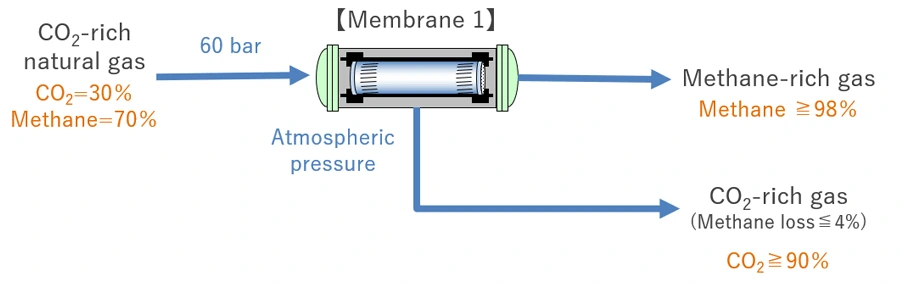
1) CO2 separation from natural gas
High-purity CH4 (methane) and CO2 can be obtained while suppressing methane loss by separating and removing the CO2 contained as an impurity in natural gas, through use of a sub-nano ceramic membrane in a one-stage membrane system.
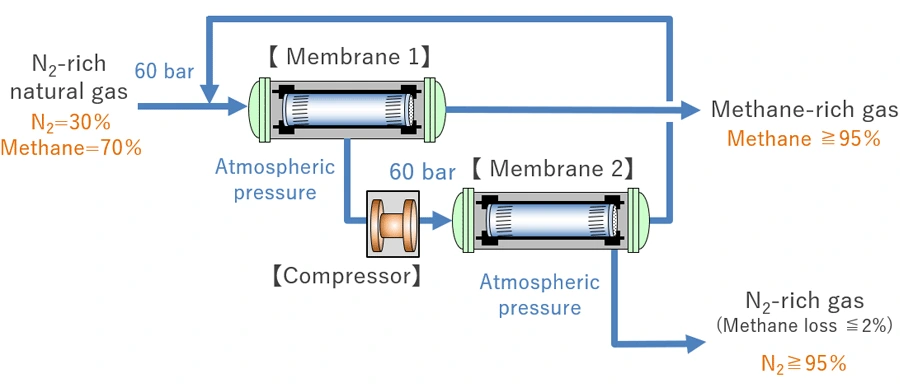
2) N2 separation from natural gas
N2 contained as an impurity in natural gas can be separated and removed using a sub-nano ceramic membrane. A two-stage membrane system makes it possible to obtain high-purity methane while suppressing methane loss.
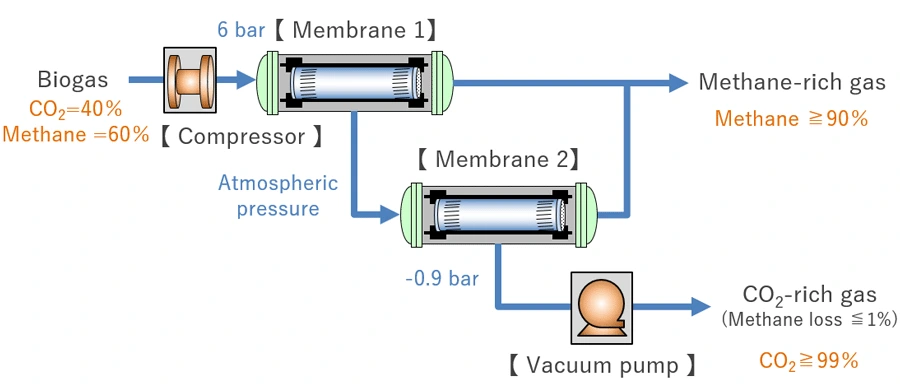
3) Biogas Purification
The biogas produced from biomass contains CH4 (methane) and CO2. Sub-nano ceramic membrane can also be used to separate and remove CO2 from biogas. A two-stage membrane system makes it possible to obtain high-purity methane and CO2.
Separation properties of sub-nano ceramic membranes
| Composition of gas mixture [mol%] |
Test conditions | Performance | ||
|---|---|---|---|---|
| Pressure of feed gas [MPaG] |
Temperature of feed gas [℃] | Composition of permeate gas [mol%] |
Separation coefficient*
[-] |
|
| CO2 : CH4 = 50 : 50 | 0.3 | 25 | CO2 > 99 | >160 |
| H2 : CH4 = 60 : 40 | 0.4 | 25 | H2 > 99 | >100 |
| N2 : CH4 = 50 : 50 | 0.4 | 25 | N2 > 96 | >30 |
| Separation method | Organic liquid | Test conditions | Dehydration performance | ||||
|---|---|---|---|---|---|---|---|
| Organic liquid concentration of feed liquid [wt%] |
Temperature of feed liquid [℃] |
Vacuum pressure at permeate side [torr] |
Water permeation rate [kg/m2h] |
Organic liquid concentration of permeate liquid [wt%] |
|||
| Pervaporation (PV) |
Alcohol | Isopropanol | 90 | 70 | 50 | 3 | <1 |
| n-Butanol | 90 | 70 | 50 | 4.5 | <1 | ||
| Ketone | Acetone | 90 | 45 | 10 | 1 | <2 | |
| Ether | Tetrahydrofuran | 90 | 50 | 10 | 4 | <1 | |
| Ester | Ethyl acetate | 97 | 70 | 50 | 6 | <1 | |
| Organic acid | Acetic acid | 30 | 90 | 200 | 9.5 | <1 | |
| Vapor permeation (VP) |
Alcohol | Ethanol | 90 | 105 | 10 | 6 | <1 |
Related Products
NGK offers a wide range of ceramic filter products with different pore sizes.