

Ceramic Membrane Emulsification based LNP Platform for Seamless Scale-up from Lab to Manufacturing
- Business fields
- Application
Overview
NGK Corporation is currently developing an LNP*1 (Lipid Nano Particle) manufacturing device utilizing membrane emulsification via a ceramic membrane for the scalable manufacturing of LNPs, which have been gaining attention as a drug delivery system (DDS) *2.
By leveraging our proprietary ceramic membrane pore size control technology, we aim to realize a manufacturing platform that can produce LNPs based on the same mixing principle from research and development through to commercial-scale production.
This technology is expected to support the development and manufacturing of LNPs, which are pivotal for the development of next-generation pharmaceuticals such as mRNA therapeutics, nucleic acid medicines, and gene therapies, thereby contributing to the broader adoption of innovative medical treatments.
- *1LNP: Nanoscale particles made from lipids
- *2DDS: Drug delivery systems that transport medicines to the required location at the appropriate amount and time
What are LNPs
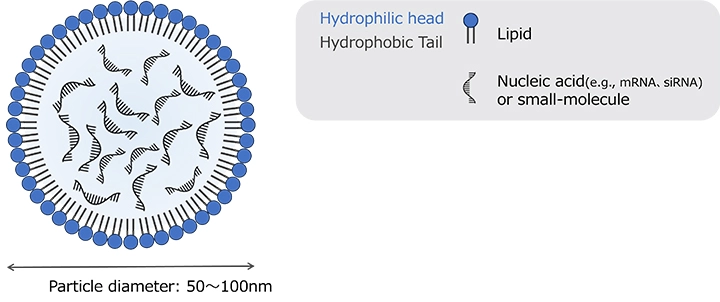
LNPs are nanoparticles made up of lipids ranging in sizes from 50~100nm in diameter. They are primarily used as drug delivery systems to deliver nucleic acids to target sites within the body. They gained widespread attention due to their successful application as an mRNA vaccine for COVID-19. Furthermore, they are expected to play a vital role as a delivery system for a variety of next generation therapeutics, such as gene therapies, cancer vaccines, and nucleic acid medicines.
LNPs are formed by the rapid and uniform mixing of a solution containing the lipid and solution containing the therapeutic agent. As a result, the mixing technology and mechanism is a critical manufacturing factor, as it directly influences the particle size and overall quality of the formulated LNPs.
Features of the LNP manufacturing device
Scalable Capacity from Lab Scale to Mass Production
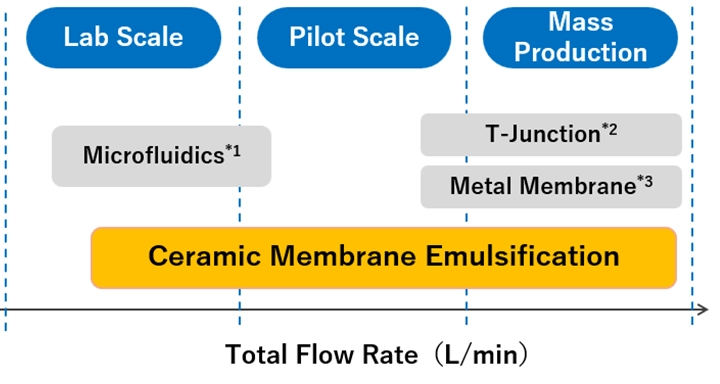
Conventional LNP mixing technologies faced limitations in applicable flow rate ranges, leading to difficulties in applying the same mixing principle across scales.
NGK aims to address this issue by controlling the pore size and effective mixing area of its ceramic membrane to enable operations across a wide flow rate range. Thus, facilitating LNP production from lab scale to mass production using the same mixing principle. Providing a scalable manufacturing platform for LNP formulations throughout the product lifecycle.
- *1Microfluidics: A method for LNP formulations by precisely mixing two liquids within micro-channels.
- *2T-Junction: A method for LNP formulations by the rapid mixing of two liquids at T-shaped junction.
- *3Metal Membrane Emulsification: A method for LNP formulations by the mixing of two liquids via the pores of a metallic membrane.
Performance Requirements for LNP Manufacturing Devices
NGK’s ceramic membrane offers unique advantages such as highly precise pore size control, flexible design of membrane area and high chemical resistance. By utilizing these strengths, NGK helps address key challenges faced in the manufacturing of LNPs.
| Challenges faced | Required Performance | Solution Provided by Ceramic Membranes |
|---|---|---|
| Scalability | Seamless scale-up from research and development to commercial production with minimal changes to manufacturing conditions | By controlling the pore size and surface area of the ceramic membrane, scalability can be achieved while maintaining the same mixing principle and manufacturing conditions |
| Single Usability | Reduced risk of cross-contamination between products and eliminate cleaning and sterilization processes | A disposable ceramic membrane configuration enables single-use operation, eliminating the need for cleaning and sterilization |
| Particle Size Control | Uniform and precise control of LNP particle sizes based on application | Uniform pores of the ceramic membrane allow even distribution of the lipid solution, enabling uniform mixing and reducing particle size variation |
| Chemical Resistance | Compatibility with next generation lipids and solvents | Chemical stability of ceramic membranes enables compatibility with a wide range of lipids and solvents. |
Regarding the prototype
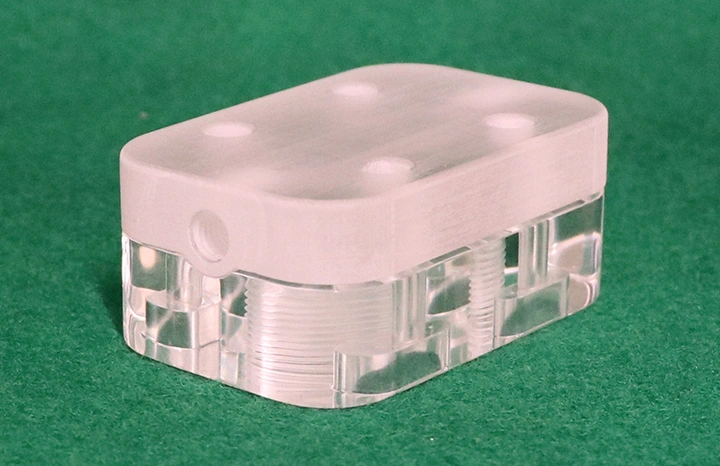
NGK can provide a prototype for our LNP manufacturing device to companies exploring the research, development, and manufacturing of LNP-based and nucleic acid therapeutics. If you are interested in evaluating our technology, please contact us through our inquiry form.
Inquiries Regarding the LNP Manufacturing Device
In addition to queries concerning the prototype, we also welcome discussions regarding the challenges faced during LNP formulations. Be it related to R&D production or scaling up to larger volumes. If you are considering prototype evaluation, collaborative development, or other initiatives, we can provide support tailored to your specific needs. Please feel free to contact us to discuss your requirements.