
NGK Formulates Sixth 5-Year Environmental Action Plan to Achieve FY2030 Targets
NGK Corporation (hereinafter, “NGK”) has formulated the Sixth 5-Year Environmental Action Plan, which outlines the environmental initiatives of the NGK Group from fiscal 2026 through fiscal 2030 toward achieving its FY2030 environmental targets.
Based on the NGK Group Environmental Vision, the NGK Group has been working to realize carbon neutrality, a circular economy, and coexistence with nature through its business activities since fiscal 2021. The newly formulated Sixth 5-Year Environmental Action Plan establishes specific targets and action items for the period from fiscal 2026 through fiscal 2030. In particular, the Group has established greenhouse gas (GHG) emissions reduction targets not only for Scope 1 and 2 emissions, but also for Scope 3 emissions, thereby strengthening its efforts to reduce environmental impact throughout the value chain.
Overview of the Sixth 5-Year Environmental Action Plan
Carbon Neutrality
The NGK Group has established a target of limiting total Scope 1 and 2 GHG emissions to 370,000 tons by FY2030, consisting of 190,000 tons of Scope 1 emissions and 180,000 tons of Scope 2 emissions. In addition, the Group has set a target of reducing Scope 3 emissions by 25% compared with FY2022 levels by FY2030.
To achieve these targets, the Group will promote energy conservation measures, expand the use of renewable energy, shift to lower-carbon fuels in production processes such as firing operations, and advance the development of innovative technologies, including CCUS (Carbon Capture, Utilization and Storage). For Scope 3 emissions, the Group will work across the entire value chain through collaboration with suppliers and initiatives to reduce environmental impacts during product use.
Circular Economy
The Group will promote resource circulation, with targets of reducing waste generation per unit of net sales and maintaining a high recycling rate.
Coexistence with Nature
Recognizing the conservation of water resources as an important priority, the Group has established a target of reducing water withdrawals per unit of net sales by 0.5% annually. To achieve this goal, the Group will continue to implement initiatives aimed at conserving water resources and reducing water-related environmental impacts.
In addition, as an initiative common to all three categories, the NGK Group will establish a framework for evaluating and visualizing contributions to reducing environmental impacts through its products. Through the development and introduction of indicators for assessing the environmental contribution of its products, the Group will promote the appropriate communication of environmental value.
Through the implementation of the Sixth 5-Year Environmental Action Plan, the NGK Group will create environmental value through both its business activities and its products and services, thereby contributing to the realization of a sustainable society.
Targets and Action Items of the Sixth 5-Year Environmental Action Plan
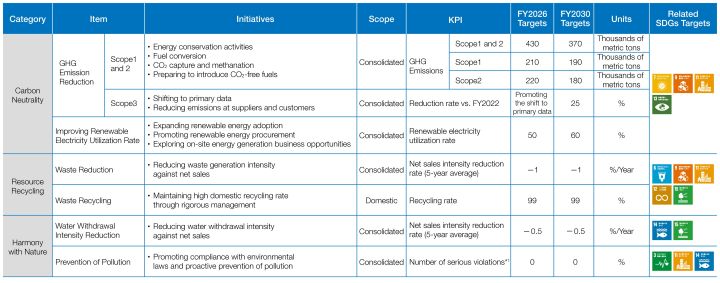
- *1Number of serious violations: The number of violations of environmental laws, regulations, ordinances, and related requirements that resulted in administrative penalties, corrective orders, or official recommendations.
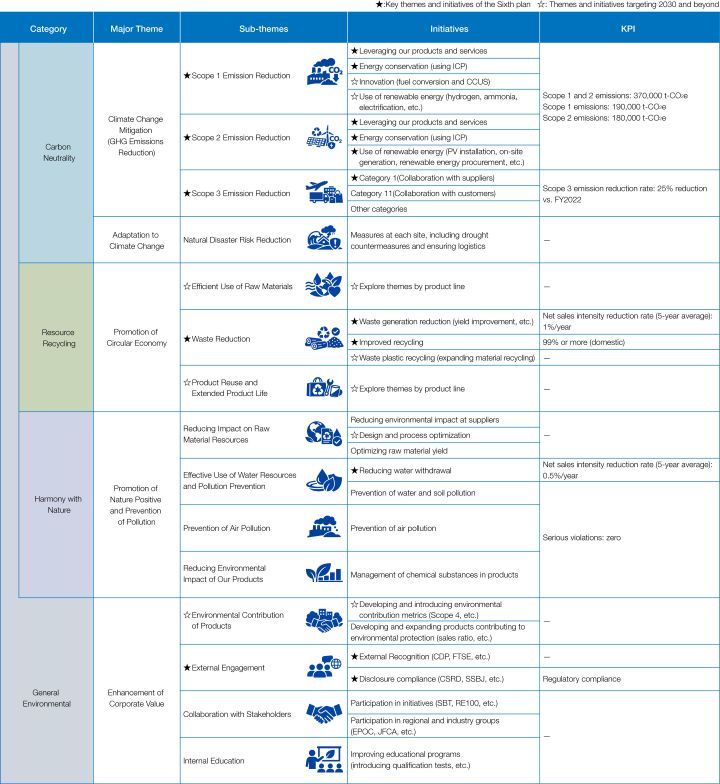
- *Scope 1:Direct greenhouse gas emissions from sources owned or controlled by the company.
Scope 2:Indirect greenhouse gas emissions resulting from the consumption of purchased electricity, heat, and steam.
Scope 3:All other indirect greenhouse gas emissions occurring throughout the value chain, excluding Scope 1 and 2 emissions.
Related Information